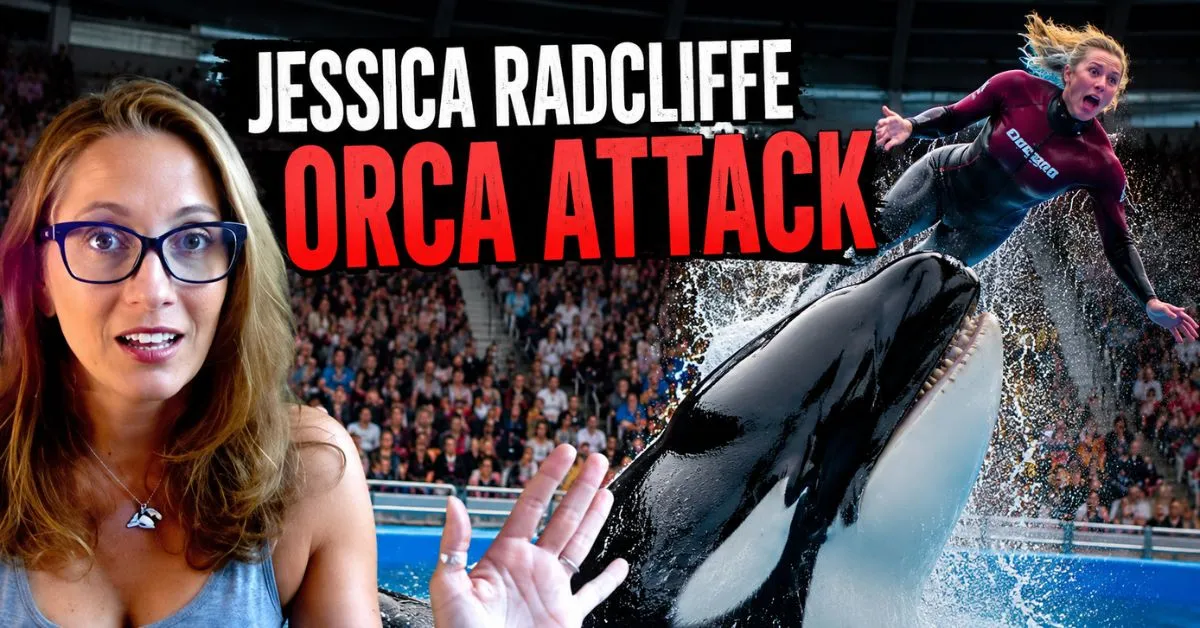
Quick answer: The “Jessica Radcliffe orca attack” is a viral 2025 hoax. A video circulating on TikTok and Facebook claimed to show a marine trainer named Jessica Radcliffe killed by an orca during a live show. Fact-checkers confirmed Radcliffe never existed—the clip was an AI-generated fabrication built from fake voiceovers and recycled footage.
Few internet stories have spread as fast, or fooled as many people, as the supposed death of orca trainer Jessica Radcliffe. The clip looked real. It felt real. Millions watched, gasped, and hit share. And yet, none of it ever happened.
This is the curious case of a woman who never lived, a tragedy that never occurred, and a video that managed to convince a huge slice of the internet otherwise. It’s a story about our appetite for the dramatic, the eerie power of AI-generated media, and how quickly a convincing lie can outrun the truth.
Related Stories



So let’s pull back the curtain. Here’s everything you need to know about the jessica dolphin accident—what the hoax claimed, how it was debunked, and why it matters far more than a fleeting viral moment.
Biography Snapshot
| Field | Details |
|---|---|
| Full Name | Jessica Radcliffe (fictional) |
| Known As | The “orca attack trainer” from a viral hoax |
| Date of Birth | Unknown — no records exist |
| Age | Not applicable (fictional persona) |
| Birthplace | Unknown — no records exist |
| Nationality | Unverified / fabricated |
| Profession | Claimed “marine trainer” (no employment records found) |
| Years Active | Not applicable |
| Known For | A fake AI-generated viral video (August 2025) |
| Relationship Status | Unknown — no records exist |
| Children | Unknown — no records exist |
| Education | Unknown — no records exist |
| Net Worth | Not applicable (person does not exist) |
| Social Media | No verified accounts; story spread via TikTok and Facebook |
A quick note before we go further: every “personal” detail attached to Jessica Radcliffe is invented. Fact-checkers at outlets including the International Business Times, Forbes, and E! News searched marine park employment records, public databases, and legitimate news archives. They found nothing. No trainer by that name, no incident, no marine park called “Pacific Blue Marine Park” where the supposed attack took place.
Where did the Jessica Radcliffe story actually come from?
The Jessica Radcliffe story began as an AI-generated video that surfaced on TikTok and Facebook in early August 2025. There was no real person behind it and no real event—just a digital fabrication designed to look like genuine footage of a marine park tragedy.
The clip claimed to show Radcliffe performing alongside an orca before a live audience, only to be killed mid-show. According to reporting from Forbes (August 11, 2025), the video carried the telltale fingerprints of synthetic media. Senior contributor John Brandon, who watched the clip himself, noted that a tragedy of that scale “would have made national news”—and yet, suspiciously, it appeared nowhere credible.
Analysts who examined the footage found AI-generated voiceovers stitched together with unrelated archival clips. There was no single authentic moment in it. The whole thing was assembled.
The video exploded because it tapped into something deeply human: our pull toward the shocking and the tragic. It didn’t break through on the strength of truth—it broke through on the strength of emotion.
One detail did a lot of heavy lifting. Some versions of the clip claimed the orca was provoked by menstrual blood in the water. As the International Business Times reported, this idea has no scientific basis whatsoever. But experts pointed out that fabricated stories often add lurid, emotionally charged details precisely because they make people feel something—and feeling something is what makes people share.
There’s real psychology underneath this. Studies on viral content consistently show we’re drawn to negative news more than positive. In his book Morbidly Curious, scientist Coltan Scrivner argues we slow down at the metaphorical car wreck because, on some instinctive level, we’re rehearsing how we’d survive it ourselves. The Radcliffe video weaponized that instinct beautifully.
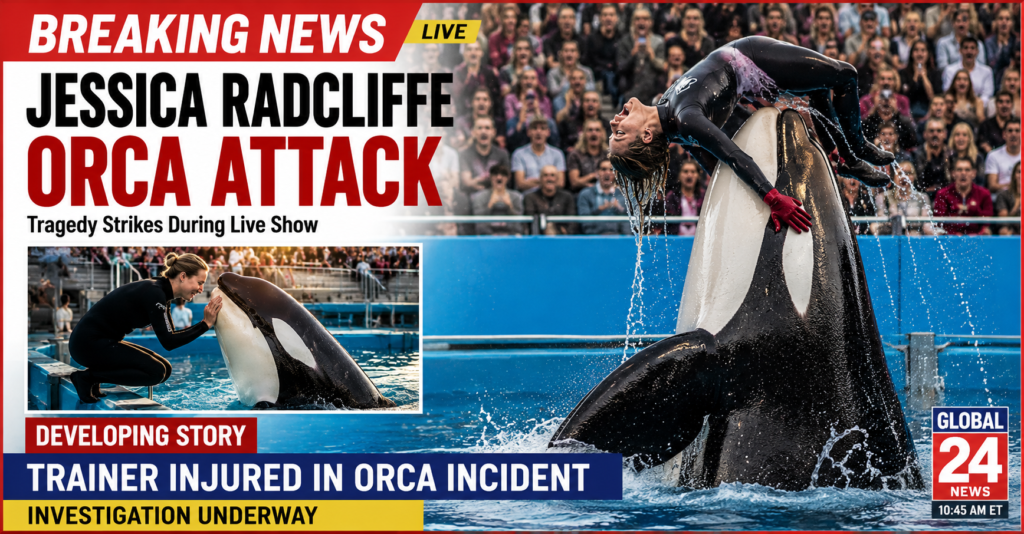
How the hoax built credibility by borrowing real tragedies
Here’s the uncomfortable part. The fake video felt believable because it leaned on two genuine, devastating events—real trainers, real deaths, real grief.
In 2009, Spanish trainer Alexis Martínez, just 29 years old, was killed at Loro Parque in Tenerife during an incident with an orca named Keto. He died of internal injuries.
A year later, in February 2010, SeaWorld Orlando trainer Dawn Brancheau, 36, was killed by an orca named Tilikum in front of a live audience. Her death was examined in depth in the 2013 documentary Blackfish, which sparked a global reckoning over keeping orcas in captivity.
Both tragedies were widely reported and painfully real. Research published in PLOS ONE confirms a pattern here: false claims frequently borrow elements from genuine events to appear more plausible. A study of COVID-19 misinformation found that many hoaxes recycled recognizable incidents to slip past people’s skepticism. The Radcliffe video followed the same playbook—it wore the clothing of real history.
If this hoax has a legacy, it’s as a textbook example of how AI-generated misinformation operates in 2025. A few moments stand out.
- The TikTok surge: The clip spread rapidly across TikTok and Facebook, racking up views faster than fact-checkers could respond.
- The fabricated venue: “Pacific Blue Marine Park,” the supposed location, doesn’t exist—a small detail that unraveled the whole story under scrutiny.
- The mainstream debunking: Within days, Forbes, E! News, and the International Business Times published detailed takedowns. The Whale and Dolphin Conservation organization publicly confirmed on Facebook that the story was false and AI-generated.
That speed of debunking is encouraging. The problem? Corrections rarely travel as far as the original lie.
The public persona that never existed
Jessica Radcliffe has no public persona, because Jessica Radcliffe is no one. There are no interviews, no verified social profiles, no colleagues who knew her, no family statements. Everything the video implied about her life was conjured by software.
That’s what makes this case so unsettling. We’re used to celebrity death hoaxes—Eminem, Jackie Chan, and Reba McEntire have all weathered them. But those involve real people who can step forward and say, “I’m alive.” Radcliffe can’t, because there’s no “her” to begin with. The hoax invented the victim and the tragedy in one stroke.
Hidden facts and lesser-known insights
A few details rarely make it into the surface-level coverage, and they’re worth knowing.
First, the platforms stayed quiet. According to Forbes, both TikTok and Meta were contacted for comment—and neither responded. The video stayed up while it was earning views, raising hard questions about whether engagement is being prioritized over accuracy.
Second, there’s the “illusory truth” effect. Psychological research warns that repeated exposure to a false claim, even when you later see it corrected, can quietly reinforce the original belief. So the Radcliffe hoax may linger in people’s memories long after the fact-checks fade.
Third, fabricated stories like this cause genuine harm beyond the obvious. As the International Business Times noted, they misinform the public about real marine animal behavior and reopen wounds for the families of trainers like Brancheau and Martínez—people who actually died.
Net worth and the economics behind the hoax
Jessica Radcliffe has no net worth, no business empire, and no income, for the simple reason that she isn’t real. But the economics of the hoax itself are very real—and that’s the story worth following.
Viral content generates traffic, and traffic generates ad revenue. Forbes raised a pointed concern: some of the most negative and sensational viral videos stay online precisely because they pull enormous engagement. In other words, there can be a financial incentive to let a shocking fake keep running. The “value” of the Radcliffe video was never in truth. It was in clicks.
Cultural impact: what this hoax says about us
The lasting impact of the Jessica Radcliffe hoax isn’t about one fake video. It’s about how easily a synthetic story can hijack millions of real emotions—and how thin the line between authentic and artificial has become.
We’ve entered an era where the uncanny valley is shrinking. Forbes noted that most AI videos still have giveaways—watch the fingers, they often move unnaturally—but the technology improves by the month. The Radcliffe clip was convincing enough to fool huge numbers of ordinarily skeptical people.
The cultural takeaway is sobering and a little empowering at the same time. We can’t outsource the responsibility entirely to social platforms. As consumers, we hold real power: pause before sharing, check whether reputable outlets are reporting the same event, and treat that emotional jolt as a cue to verify rather than repost.
Social media presence and how the story spread
The Jessica Radcliffe story lived almost entirely on social media—primarily TikTok and Facebook—and never on any verified personal account, because the persona was fabricated. Its spread was the whole point.
False news, research consistently shows, travels far wider than its correction. That asymmetry is exactly why the hoax thrived. By the time the debunkings arrived, the clip had already lodged itself in countless feeds and memories.
If you want a practical defense, The Guardian recommends a few quick checks for any viral video:
- Confirm whether multiple reputable news outlets have reported the event.
- Run a reverse image or video search to trace the original source.
- Watch for manipulation signs: mismatched audio and lip movements, unnatural lighting, or glitches around the mouth and jaw.
For more on this growing challenge, you might explore our coverage of [AI deepfakes and how to spot them], our deep dive into [the Blackfish documentary and the orca captivity debate], and our guide to [why celebrity death hoaxes keep going viral]. You may also find value in our reporting on [how misinformation spreads on TikTok] and [the real history of marine park safety incidents].
Frequently asked questions
What is the Jessica Radcliffe orca attack?
It’s a viral hoax from August 2025. A video on TikTok and Facebook claimed a marine trainer named Jessica Radcliffe was killed by an orca during a live show. Fact-checkers confirmed she never existed and the clip was AI-generated.
Is the Jessica Radcliffe video real?
No. Experts confirmed the video is an AI-generated fabrication that combined synthetic voiceovers with unrelated archival footage. There is no record of the trainer or the attack.
Did a real orca trainer die like in the video?
Not Jessica Radcliffe—she isn’t real. But the hoax borrowed from two genuine tragedies: Alexis Martínez, who died in 2009 at Loro Parque, and Dawn Brancheau, who was killed by the orca Tilikum at SeaWorld in 2010.
It tapped into our pull toward shocking, emotional content and added a false, sensational detail about menstrual blood to encourage sharing. Borrowing from real incidents also made it feel believable.
Check whether trusted news outlets are reporting it, run a reverse image or video search, and look for telltale signs of AI manipulation like mismatched audio, odd lighting, or glitches around the face.
The real lesson behind a fake tragedy
Jessica Radcliffe never trained an orca. She never stepped onto a stage, never took a bow, never existed at all. And yet her invented story reached more people than most real news ever will. That’s the quiet warning buried inside this whole episode.
The good news is that the truth caught up—reputable outlets debunked the clip within days, and you now know exactly how to spot the next one. The next time a video stops you cold and begs to be shared, treat that feeling as a prompt to verify, not to repost. A few seconds of skepticism is the most powerful tool any of us has.
Want to sharpen those instincts further? Take a look at our companion piece on [recognizing AI-generated media in your feed]—because the next Jessica Radcliffe is almost certainly already being made.

Emma Clarke is a content writer at Gaukurinn.is, specializing in celebrity news, pop culture, movies, and music. With a strong focus on accuracy and trending topics, she creates engaging and well-researched articles that keep readers informed and entertained.
Emma follows trusted sources and editorial standards to ensure content is reliable, relevant, and up to date. Her goal is to deliver clear, valuable information that readers can trust.