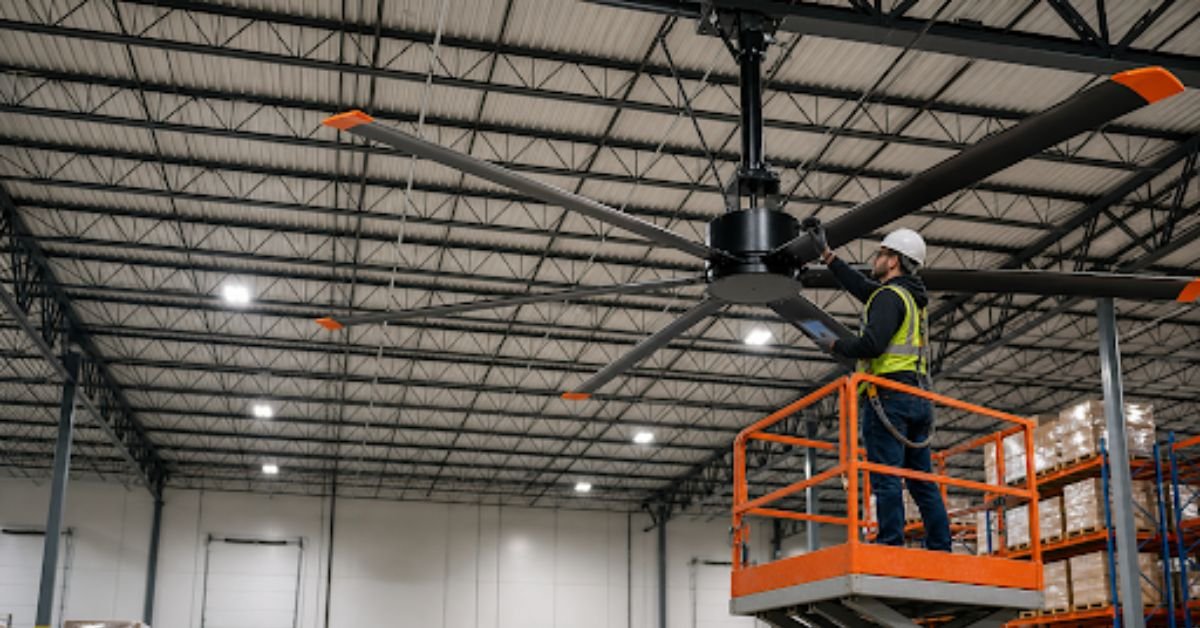
A practical guide to inspection frequency, cleaning, warning signs, preventive maintenance, and the components facility teams should monitor.
Short answer: Yes. HVLS fans require routine maintenance, but the maintenance burden is generally relatively low. Most upkeep centers on visual inspection, cleaning, checking mounting and safety components, and responding to unusual noise, vibration, or control faults. The exact schedule should follow the fan manufacturer’s instructions and may need to be more frequent in dusty, humid, corrosive, or high-use environments.
For facility managers, the key distinction is that low maintenance does not mean maintenance-free. A well-selected and properly installed system should not require constant attention, but periodic checks help identify small problems before they become safety concerns, downtime, or larger repair issues.
Related Stories



How Much Maintenance Does an HVLS Fan Actually Require?
Most HVLS maintenance is preventive rather than intensive. In day-to-day operation, facility staff are usually watching for changes in how the fan sounds, moves, and responds to controls. Cleaning and scheduled inspections then address the items that cannot be evaluated reliably from the floor.
When comparing an HVLS fan for a warehouse, production area, gym, showroom, or other large space, maintenance should be considered alongside airflow coverage, motor design, controls, mounting requirements, operating hours, and the environment in which the fan will run.
A practical way to think about the work is in three layers: routine observation, periodic cleaning, and scheduled technical inspection. Corrective service is then performed when a specific fault, damaged component, or abnormal operating condition is found.
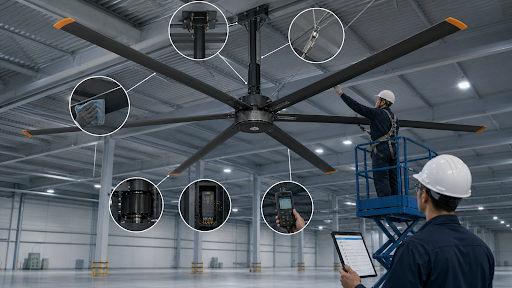
How Often Do HVLS Fans Need Maintenance?
There is no single maintenance interval that applies to every HVLS fan. Many facilities include a more comprehensive fan inspection in an annual preventive-maintenance plan, while carrying out simpler visual observations more frequently. The correct interval depends on the fan model, operating hours, ceiling environment, airborne dust or contaminants, and the manufacturer’s requirements.
A fan that runs seasonally in a clean commercial building does not face the same conditions as a fan operating long hours in a dusty manufacturing facility. For that reason, a calendar schedule should be treated as a planning framework rather than a substitute for the model-specific maintenance instructions.
| Maintenance Level | What to Check | Typical Trigger |
| Routine observation | Listen for unusual noise; watch for vibration, wobble, unexpected stops, or abnormal movement. | During normal facility checks |
| Cleaning | Remove excessive dust and debris from blades/airfoils and accessible exterior surfaces. | When buildup becomes noticeable |
| Periodic inspection | Review visible hardware, blades, safety components, and controller status. | Per facility and manufacturer schedule |
| Comprehensive inspection | Evaluate mounting, safety restraints, motor/drive components, controls, and overall operation. | Often included in annual planning |
| Corrective service | Diagnose faults, damaged components, excessive vibration, or abnormal electrical/control behavior. | As soon as an issue is identified |
What Parts of an HVLS Fan Need Maintenance?
Mounting Hardware and Support Structure
The mounting system deserves regular attention because it supports the entire rotating assembly. Inspections should look for visible looseness, damaged brackets, missing or compromised fasteners, corrosion, structural movement, or any sign that the fan is no longer securely supported. Technical checks should be performed using the manufacturer’s procedures and required torque specifications rather than by casually tightening hardware.
Safety Cable and Guy Wires
Many HVLS installations include a secondary safety cable, and some installations also use guy wires or stabilizing cables. These components should be checked for visible damage, fraying, looseness, poor routing, or contact with sharp surfaces. Guy wires are not used on every fan, so the applicable inspection points depend on the specific installation.
Blades or Airfoils
Large blades or airfoils should be checked for heavy dust buildup, impact damage, deformation, loose components, or anything that could affect smooth rotation. Even when a fan continues to run, an obvious change in blade condition should be investigated rather than left until the next major service interval.
Motor and Drive System
HVLS fans can use different motor and drive architectures. Depending on the design, inspection may include the motor, bearings, gearbox, direct-drive assembly, and associated components. Warning signs include new mechanical noise, excessive heat, changes in speed, vibration, or repeated faults.
Electrical and Control System
Controllers, variable-frequency drives where applicable, wiring enclosures, and electrical connections should remain in good condition. Facility staff can note fault codes, unexpected starts or stops, or control problems from the operating interface, but internal electrical inspection should be handled by qualified personnel using the correct shutdown and lockout procedures.
How Do You Clean an HVLS Fan?
Cleaning is one of the most common routine maintenance tasks because large ceiling-mounted fan surfaces can collect dust, fibers, or process debris. The required frequency is environmental: a clean retail or gym space may need less frequent cleaning than a warehouse, woodworking area, or production facility with airborne particles.
Before cleaning, the fan should be shut down according to the applicable safety procedure and allowed to stop completely. Use the cleaning method approved for the specific fan, remove loose dust and debris from blades or airfoils, and avoid introducing moisture into electrical components unless the manufacturer specifically permits it. High-mounted fans may require lifts, fall-protection procedures, and trained personnel.
Cleaning should also be treated as an inspection opportunity. If staff notice a damaged blade, loose part, corrosion, cable damage, or unexpected movement while cleaning, the issue should be recorded and escalated for technical evaluation.
Do HVLS Fans Need Lubrication?
Not necessarily. Lubrication requirements depend on the fan’s motor and drive design. Some components may be sealed or designed without routine field lubrication, while other systems may have specific service points or lubricant requirements. Do not add oil or grease simply because the fan is industrial equipment. Follow the maintenance instructions for the exact model and use only the specified lubricant, interval, and procedure when lubrication is required.
What Are the Signs That an HVLS Fan Needs Maintenance?
Scheduled maintenance is important, but condition-based warning signs are just as useful. A fan should be investigated when its behavior changes noticeably, especially after an impact, electrical event, building work, or long period of heavy use.
| Warning Sign | What It May Indicate |
| Clicking, grinding, or rubbing | A loose, worn, contacting, or damaged component. |
| Excessive vibration | A mounting, blade, balance, motor, or drive-related issue. |
| Visible wobble | An installation or component condition that needs inspection. |
| Reduced or inconsistent speed | A motor, drive, control, or electrical issue. |
| Controller or VFD fault | A control-system, drive, or electrical condition requiring diagnosis. |
| Damaged blade or airfoil | Physical impact, deformation, or material damage. |
| Loose visible hardware | A mounting or structural concern. |
| Unexpected stopping or restarting | A control, electrical, or motor-related issue. |
Abnormal vibration, damaged mounting components, compromised safety restraints, or electrical faults should be investigated promptly rather than left until the next scheduled inspection.
Can Facility Staff Maintain an HVLS Fan?
Facility staff can play an important role in maintenance without performing every technical task themselves. Ground-level monitoring is useful for identifying noise, vibration, unusual movement, reduced performance, fault messages, or visible debris. Staff can also record the fan ID, date, operating condition, and any change they observe so that a technician has better information when service is needed.
Work involving height access, mounting hardware, safety cables, electrical enclosures, motor or drive components, or blade removal should be assigned according to the manufacturer’s instructions and the facility’s safety rules. In many commercial and industrial settings, that means using trained maintenance personnel or a qualified service technician.
Does the Operating Environment Change Maintenance Needs?
Yes. Environment can be as important as the calendar when setting a maintenance plan. A practical program accounts for what is in the air, how long the fan runs, and whether moisture, chemicals, dust, or production processes can accelerate buildup or deterioration.
Dusty Warehouses and Distribution Centers
Cardboard fibers, general dust, and airborne debris may accumulate on airfoils and accessible surfaces. More frequent visual checks and cleaning may be appropriate when buildup becomes noticeable.
Manufacturing and Process Areas
Production environments may contain fine particles, oil mist, fibers, or other contaminants. The maintenance plan should account for the actual process rather than assuming all industrial spaces have the same exposure.
Humid or Corrosive Environments
Moisture and corrosive contaminants can change inspection priorities. Visible corrosion, enclosure condition, fasteners, cabling, and other exposed components may require closer monitoring, subject to the fan’s environmental rating and manufacturer guidance.
High-Use Facilities
Fans that operate for long shifts or near-continuously accumulate more operating hours than fans used only during seasonal occupancy. In these cases, operating hours and condition-based observations may be more useful than relying on a calendar alone.
Do Direct-Drive HVLS Fans Require Less Maintenance?
Direct-drive designs can eliminate some mechanical drivetrain components used in geared systems, which may simplify certain maintenance tasks. That does not make every direct-drive fan maintenance-free, nor does it guarantee lower lifetime service costs in every application. Overall maintenance still depends on the motor design, bearings, controls, mounting system, operating environment, installation quality, and manufacturer requirements.
For buyers comparing an HVLS Industrial Ceiling Fan, the better question is not simply whether the fan is direct-drive or geared, but which design is appropriate for the facility and what the documented inspection and service requirements are over time.
Can Preventive Maintenance Help an HVLS Fan Last Longer?
Preventive maintenance cannot guarantee a specific service life, but it can help identify conditions that contribute to premature wear or unplanned downtime. Loose hardware, damaged blades, abnormal vibration, electrical faults, corrosion, and excessive dirt buildup are easier to address when they are found early.
Actual service life depends on the fan design, operating hours, environment, installation quality, control strategy, and component condition. For that reason, maintenance records are useful: they create a history of inspections, observed changes, repairs, and recurring issues that can support better service decisions.
HVLS Fan Maintenance Checklist
A checklist helps standardize what facility teams look for and makes it easier to document changes from one inspection to the next.
| Check | Routine | Periodic | Technical / Professional |
| Listen for abnormal noise | ✓ | ||
| Observe vibration or wobble | ✓ | ||
| Check fan response to controls | ✓ | ||
| Review visible blade condition | ✓ | ✓ | |
| Remove excessive dust and debris | ✓ | ||
| Inspect mounting hardware | ✓ | ✓ | |
| Inspect safety cable | ✓ | ✓ | |
| Check guy wires if installed | ✓ | ✓ | |
| Review controller / drive faults | ✓ | ✓ | ✓ |
| Inspect internal electrical components | ✓ | ||
| Inspect motor / drive components | ✓ | ||
| Record inspection findings and repairs | ✓ | ✓ |
Frequently Asked Questions
Do HVLS fans require regular maintenance?
Yes. HVLS fans require routine inspection and cleaning, although the maintenance burden is generally relatively low. The exact tasks and intervals depend on the fan design, manufacturer instructions, operating hours, and environment.
How often should an HVLS fan be inspected?
Follow the manufacturer’s maintenance schedule for the specific fan. Many facilities also perform routine visual observations and include a more comprehensive inspection in their scheduled preventive-maintenance program.
How often should HVLS fan blades be cleaned?
Clean based on environmental conditions and visible buildup rather than assuming one interval works everywhere. Dusty or process-heavy facilities may need more frequent cleaning than clean commercial spaces.
Do HVLS fans need lubrication?
Some designs may have specific lubrication requirements while others may not require routine field lubrication. Use the model-specific maintenance instructions and do not add lubricant unless it is specified.
Can an HVLS fan run 24/7?
That depends on the specific model, application, operating limits, and facility conditions. Continuous operation also increases operating hours, which may affect how the maintenance schedule is planned.
Why is my HVLS fan wobbling?
Visible wobble can be associated with mounting, blade, alignment, balance, motor, or drive issues. Stop treating it as normal behavior and have the condition evaluated according to the manufacturer’s troubleshooting and service procedures.
Can facility staff maintain HVLS fans?
Facility staff can monitor noise, vibration, visible condition, operation, and controller alerts. Work at height or involving mounting, electrical, motor, safety-restraint, or internal drive components may require trained or qualified personnel.
Does regular maintenance help HVLS fans last longer?
Preventive maintenance can help detect conditions that contribute to wear, faults, or downtime before they become larger problems. Actual service life still depends on design, environment, operating hours, installation quality, and component condition.
The Bottom Line
HVLS fans do require maintenance, but routine upkeep is generally straightforward: observe how the fan operates, keep blades and accessible surfaces clean, inspect mounting and safety components on the appropriate schedule, and act when noise, vibration, damage, or control faults appear. The maintenance plan should always be tailored to the specific fan and facility rather than copied from a generic interval.
For organizations evaluating large-air-movement solutions, Breezary offers HVLS fan options for commercial and industrial applications. Comparing airflow needs, installation conditions, motor and control design, operating hours, and documented maintenance requirements before purchase can make long-term facility planning more predictable.

Emma Clarke is a content writer at Gaukurinn.is, specializing in celebrity news, pop culture, movies, and music. With a strong focus on accuracy and trending topics, she creates engaging and well-researched articles that keep readers informed and entertained.
Emma follows trusted sources and editorial standards to ensure content is reliable, relevant, and up to date. Her goal is to deliver clear, valuable information that readers can trust.