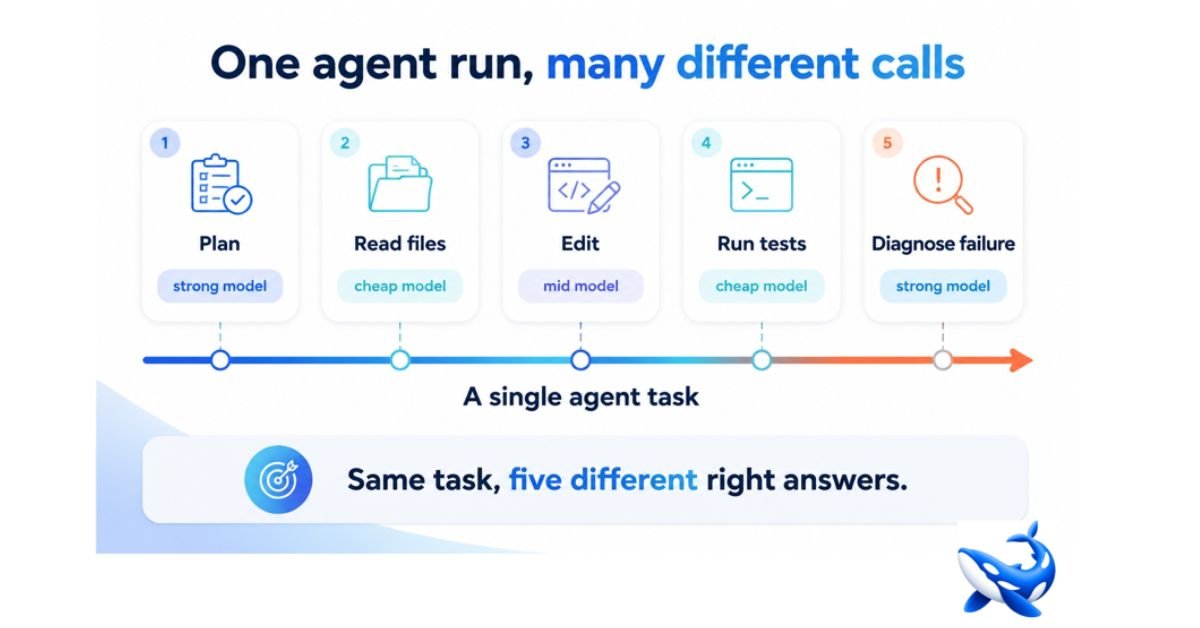
Most routing advice assumes one request, one answer, one decision. Coding agents break that assumption: a single task becomes hundreds or thousands of model calls, and they are not the same kind of call. OrcaRouter sits in front of that traffic, and putting an AI router inside an agent loop changes what you optimise for — the unit that matters stops being the request and becomes the completed task.
For scale: one vendor’s published demonstration had a model working across more than 1,000 tool calls over 24 hours on a single optimisation problem. At that length, small per-call differences compound into large ones.
Why per-request thinking fails here
Three things change when the caller is an agent rather than a person.
Related Stories


The calls are heterogeneous. Planning the change is a hard reasoning problem. Reading a file is not. Deciding which test to run is trivial. Diagnosing why the test failed is hard again. Routing all of that to the same model means paying reasoning prices for file reads, or getting weak planning to save money on them.
Nobody is waiting. In an interactive product, first-token latency is the experience. In a background agent run, a seven-second first token is invisible — what matters is whether the run finishes and whether it was right. This inverts the usual latency-first advice. Our own seven-day production telemetry has models ranging from 444 ms to 7.73 seconds at p50; in an agent loop that spread is worth trading away for capability in the steps that need it.
Errors compound. A 3% failure rate on a single call is invisible. Across 1,000 sequential calls it is close to certain that something derails. Reliability stops being a nice property and becomes the dominant one.
What to route on inside a loop
Step type, not prompt difficulty. The most effective signal is what the agent is doing. Plan and diagnose steps to a strong model; read, list, format and simple-edit steps to a cheap one; test execution and tool-result summarisation to the cheapest thing that can read the output correctly.
Because agent frameworks generally know their own step type, this is a case where explicit rules beat inference — a routing DSL expressed as YAML plus a condition language, kept in version control, encodes “planning steps go to tier A” better than any grader can infer it.
Context size. Long-horizon runs accumulate enormous state: tool outputs, failed attempts, prior reasoning. Some steps need all of it; most don’t. Routing large-context steps to a model that handles them well, and short steps to something fast, is a large win that’s easy to implement.
Cache-friendliness. In an agent loop the same prefix — repository, instructions, tool definitions — repeats on nearly every call. Cached input is typically billed at a fraction of the normal rate (on one model we serve, $0.15 against $1.25, an 88% reduction). Structuring prompts so the invariant part comes first and stays byte-identical is usually a bigger saving than tier-routing, and it costs nothing in quality. Do it first.
The cost arithmetic is different
Two corrections to the usual model.
Reasoning tokens bill as output. Models that deliberate consume far more output tokens than their list price implies — we’ve seen one burn 95 million output tokens on a benchmark where the tier median was 70 million. In an agent loop that multiplies across every call. Forecast in cost per completed task; a token-price ranking and a task-cost ranking are frequently different orders.
A cheap model that fails is expensive. If a weaker model makes a wrong edit that the agent then spends forty calls discovering and reverting, the cheap tier cost you more than the strong one would have. This is the specific way naive cost-routing backfires in agent workloads and doesn’t in single-request ones. Route the *decision* steps up, even when they’re a small fraction of calls — they determine how many calls the rest of the run needs.
Reliability is the real requirement
Across a run of that length, provider failures stop being hypothetical.
What you want: a fallback chain that crosses providers, with retries handled before the response starts streaming so the agent sees one successful response rather than an error it has to interpret. Agents handle errors poorly — an unexpected failure mid-run often produces a confused recovery attempt that costs more than the retry would have. Health-aware balancing that removes an unhealthy upstream automatically matters more here than in request/response traffic, because nobody is watching.
Check the fallback’s capabilities, not just its quality. If your primary handles a large context and your fallback doesn’t, the failover will break on exactly the late-run calls that carry the most accumulated state.
Instrument the run, not just the request
Agent debugging is genuinely hard, and per-call records are what make it possible. For every call you want the model, the grade behind the routing choice, the latency and the cost — and the ability to copy the call as cURL so a failing step can be reproduced in isolation.
The questions that come up are all cross-call: which step type is consuming the budget, is the escalation rate climbing, did the run get more expensive after a lineup change, which model was answering when the agent went off the rails. None of those are answerable from a total.
Set your timeouts from p95, not p50, and set them generously. Agent frameworks with a default timeout tuned for chat will fail against a deliberate model in ways that look like bugs.
Agent runs are also where free tiers go furthest, because most of the calls are mechanical. A rotating set of free LLM API models is callable at $0 per token — enough to route the read, list and format steps of a real run for nothing while you work out which steps actually deserve a paid model.
The takeaway
Inside an agent loop the routing question changes shape. The calls are heterogeneous, so route on step type rather than inferred difficulty. Nobody is waiting, so trade latency for capability where the step deserves it. Errors compound across a thousand calls, so cross-provider failover with pre-stream retries matters more than it does anywhere else. And fix your prompt caching before you tier anything, because the repeated prefix in an agent loop is usually the largest single line in the bill. Measure in cost per completed task — in this workload, cost per token will lead you to the wrong model.
Sourcing note: routing rules, fallback behaviour, per-call logging and integration support are OrcaRouter’s own published product descriptions. The 1,000-tool-call demonstration and the 95-million-output-token figure are a vendor’s published claim and an independent evaluation respectively, not our measurements. Latency percentiles are our own seven-day production telemetry; prices are providers’ list prices passed through at 0% markup. Checked August 9, 2026.
CLICK HERE FOR MORE BLOG POSTS

Emma Clarke is a content writer at Gaukurinn.is, specializing in celebrity news, pop culture, movies, and music. With a strong focus on accuracy and trending topics, she creates engaging and well-researched articles that keep readers informed and entertained.
Emma follows trusted sources and editorial standards to ensure content is reliable, relevant, and up to date. Her goal is to deliver clear, valuable information that readers can trust.