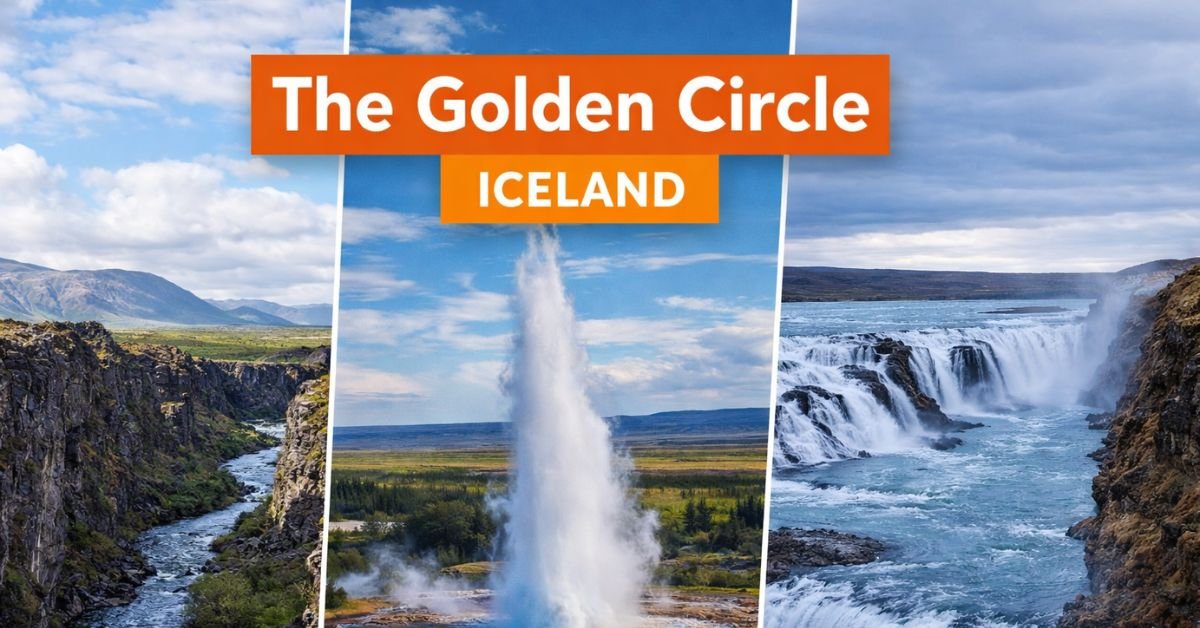
You’re standing on the edge of a continent. Literally. The rock beneath your feet is the North American tectonic plate. Across the valley — maybe 50 metres away — that’s Europe. And between the two, the Earth is tearing itself apart at about 2 centimetres per year.
That’s Þingvellir National Park, and it’s just the first stop on the Golden Circle.
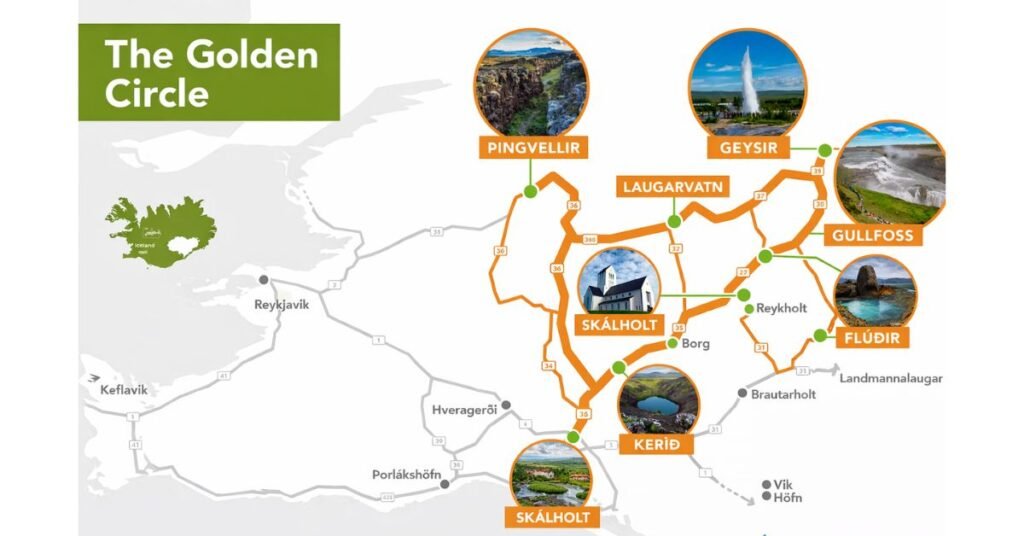
The Golden Circle is a 300-kilometre driving loop in southwest Iceland that connects three of the country’s most extraordinary natural landmarks: Þingvellir National Park, the Geysir geothermal area, and Gullfoss waterfall. It starts and ends in Reykjavík, fits neatly into a single day, and manages to pack in a UNESCO World Heritage Site, an erupting geyser, a 32-metre waterfall, and the visible boundary between two tectonic plates — all before dinner.
Related Stories
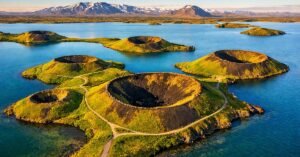
Iceland welcomed over 2.5 million international visitors in 2025, and roughly 60% of them visited Geysir and Gullfoss. The Golden Circle isn’t just popular. It’s the default first day for almost everyone who visits this country. And in 2026, there’s an added reason to make the trip: on August 12, Iceland will experience a total solar eclipse — the first visible from the island in more than 70 years. The Golden Circle region sits in one of the best viewing corridors.
This guide covers everything: the three main stops in detail, hidden detours worth your time, tour vs. self-drive logistics, seasonal strategy, realistic costs, the 2026 eclipse, and the myths that keep getting repeated online. Whether you’re booking your first tour from Reykjavík or planning a self-drive with a rental car, the goal here is to give you one page that replaces the 20 tabs you currently have open.
What Is the Golden Circle, Exactly?
The Golden Circle — Gullni hringurinn in Icelandic — is a roughly triangular scenic route that loops northeast and east of Reykjavík through the Icelandic highlands. The name comes from Gullfoss (“Golden Falls”), the anchor waterfall on the route. On sunny days, the glacial mist above Gullfoss catches the light and throws golden rainbows across the canyon. The “circle” part refers to the loop itself: you can drive it in either direction and return to the capital without backtracking.
The three headline stops are Þingvellir National Park (tectonic plates and Viking-age parliament), the Geysir geothermal area (erupting geyser and bubbling hot springs), and Gullfoss (massive two-tiered waterfall fed by a glacier). The route follows Routes 36, 365, 37, and 35 — all paved, all well-signed, and all manageable in a standard rental car during summer.
Total driving time without stops is roughly 3 to 3.5 hours. Most people spend 6 to 8 hours on the full loop, and that’s with moderate time at each location. Extend it to two days and you’ll have room for hot springs, crater lakes, farm visits, and actual relaxation.
Stop 1: Þingvellir National Park — Where Two Continents Split Apart
The Geology
Þingvellir sits directly on the Mid-Atlantic Ridge, the massive underwater mountain range where the North American and Eurasian tectonic plates diverge. Iceland is one of the very few places on Earth where this ridge rises above sea level, and Þingvellir is the spot where you can see the results most dramatically.
The park occupies a rift valley — a sunken zone created by the two plates pulling apart. The Almannagjá gorge is the largest visible crack, a proper canyon that you can walk through on a well-maintained path. As you enter from the Reykjavík side, you descend into the valley along the edge of the North American plate. The cliff face you’re looking at is the continental boundary. The corresponding Eurasian plate edge rises on the far side of the valley. The gap between them widens by roughly 2 to 2.5 centimetres every year, and it has been doing so for millennia.
The History
Þingvellir means “Assembly Plains,” and the site has been politically significant since 930 AD, when Icelandic chieftains established the Alþingi — widely cited as the world’s oldest surviving parliament. For over 800 years, lawmakers gathered at Lögberg (the Law Rock) to pass laws, settle disputes, and make announcements to crowds assembled in the natural amphitheatre created by the rift valley’s acoustics. The parliament met at Þingvellir until 1798 before relocating to Reykjavík.
In the year 1000, Iceland’s peaceful conversion to Christianity was decided at this site — a remarkable moment of consensus politics in the Viking Age. And in 1944, the Republic of Iceland was formally proclaimed here.
Þingvellir became Iceland’s first national park in 1930, and UNESCO designated it a World Heritage Site in 2004 — primarily for its cultural significance, though its geological credentials are equally extraordinary.
What to Do at Þingvellir
Walk through Almannagjá gorge. The main path runs between the fractured edge of the North American plate and a collapsed section of the old rift wall. It ends at Öxarárfoss, a charming waterfall where the Öxará river drops over the lava edge. The walk takes about 20 to 30 minutes at a comfortable pace.
Snorkel or dive in Silfra fissure. This is one of the Golden Circle’s most memorable add-ons. Silfra is a crack between the tectonic plates that filled with glacial meltwater filtered through porous lava rock for decades. The result is water with over 100 metres of visibility — among the clearest on the planet. You’re quite literally swimming between two continents. Water temperature hovers around 2–4°C year-round, so a drysuit is mandatory. Advance booking is essential, as spots fill up quickly.
Visit Þingvallavatn. Iceland’s largest natural lake borders the park to the south. Fed by underground springs and glacial meltwater from Langjökull, the lake is home to a unique population of Arctic charr that has evolved into four distinct forms — a biological curiosity that caught UNESCO’s attention.
Practical details: Þingvellir is roughly 45 minutes from Reykjavík via Route 36. Parking uses a digital payment system (CheckIt app or pay at the visitor centre). Budget 1 to 2 hours for the main sights; add 2 to 3 hours if you’re snorkelling at Silfra.
Stop 2: The Geysir Geothermal Area — Where the Earth Breathes
The Star: Strokkur
The geothermal area at Haukadalur Valley is where the English word “geyser” was born. The original Geysir (sometimes called the Great Geysir) was first documented in 1294 and once hurled water as high as 70 metres. It gave its name to every geyser on the planet. But the Great Geysir has been largely dormant since 2003, so the real show now belongs to its neighbour, Strokkur.
Strokkur erupts every 5 to 10 minutes, reliably, all day, every day. Each eruption sends a column of boiling water 15 to 20 metres into the air, though it occasionally reaches up to 40 metres. The sequence is mesmerising to watch: the turquoise pool at the surface begins to swell, a dome of water forms, and then the whole thing detonates upward in a burst of steam and spray. You can watch it happen a dozen times if you want, and you’ll probably find yourself doing exactly that.
Strokkur was first recorded in 1789 after an earthquake unblocked its conduit. It went dormant again in the early 20th century when another earthquake sealed the vent, and was revived in 1963 when locals cleared the blockage on the advice of the Geysir Committee. It’s been active ever since.
Beyond the Geyser
The broader geothermal field is worth exploring. Bubbling mud pots, hissing fumaroles, and vivid mineral-stained hot springs are scattered across the area, connected by boardwalks and marked paths. Blesi, a pair of connected pools — one milky blue, one clear — is a favourite photo stop. Litli Geysir (“Little Geysir”) sputters away nearby, less dramatic but no less interesting.
The entire area is free to visit. No entrance ticket, no timed slots. Parking is free. The Geysir Centre next to the lot has a restaurant, gift shop, and facilities.
One crucial note: the water here is genuinely scalding. Surface temperatures near the vents reach 95°C or higher. Stay on the marked paths and behind the safety ropes, and keep a close eye on children.
Practical details: The Geysir area is about 1 hour 20 minutes from Reykjavík via Route 35, or about 50 minutes from Þingvellir if you’re driving the loop clockwise. Most visitors spend 30 minutes to an hour here. Arrive early (before 10 a.m.) or late in the afternoon to avoid the worst crowds.
Stop 3: Gullfoss — The Waterfall That Almost Wasn’t
The Falls
Gullfoss — “Golden Falls” — is a two-tiered waterfall on the Hvítá River, fed by meltwater from Langjökull, Iceland’s second-largest glacier. The upper cascade drops 11 metres, the river turns sharply 90 degrees, and then the lower cascade plunges another 21 metres into the narrow Gullfossgjúfur canyon. The total height is 32 metres, but what makes Gullfoss genuinely jaw-dropping isn’t the height — there are taller waterfalls in Iceland. It’s the volume.
In summer, roughly 140 cubic metres of water thunder over the falls every second. That’s enough to fill an Olympic swimming pool in under a minute. The canyon walls rise up to 70 metres high, concentrating all that power into an enclosed space that you can feel in your chest before you even see the water. On sunny days, rainbows arc through the mist — the golden shimmer that gave the waterfall its name.
From certain angles, the river appears to vanish into the earth. The L-shaped configuration of the two drops, set at nearly right angles to each other, creates an optical illusion where the water simply disappears into a crack in the landscape. You don’t fully see the canyon until you’re right at the edge.
The Conservation Story
Gullfoss nearly became a hydroelectric power station. In the early 20th century, foreign investors leased the land from the waterfall’s owners and planned to dam the Hvítá River. Sigríður Tómasdóttir, the landowner’s daughter, fought the plan for years. She walked repeatedly from her farm to Reykjavík — over 120 kilometres each way — to protest, and reportedly threatened to throw herself into the falls if the dam was built.
She enlisted the help of a lawyer named Sveinn Björnsson, who eventually had the investors’ contract annulled. Björnsson later became Iceland’s first president. Sigríður is now remembered as Iceland’s first environmentalist. A stone memorial bearing her likeness stands above the falls. In 1979, Gullfoss was declared a permanent nature reserve.
Visiting Gullfoss
There are two viewing levels. The upper platform offers a panoramic overview of both tiers and the canyon. The lower path brings you much closer to the falls — close enough that the spray will soak you even in waterproof gear. In winter, the lower path is typically closed due to ice.
Practical details: Gullfoss is about 10 minutes’ drive from Geysir and roughly 1 hour 45 minutes from Reykjavík. Parking is free at both the upper and lower car parks. No entrance fee. The Gullfoss Café by the upper lot serves lamb soup, sandwiches, and coffee year-round. Budget 30 to 60 minutes here; up to 90 if you want to walk both viewpoints thoroughly.
Beyond the Big Three: Hidden Stops Worth Adding
The three main attractions are the reason the route exists, but several side stops can transform a solid day trip into something richer.
Kerið Crater — A 6,500-year-old volcanic crater about 15 minutes south of Geysir. Unlike most Icelandic craters, Kerið didn’t form from an eruption — the cone collapsed after its magma chamber emptied. The result is vivid red and orange slopes surrounding a brilliant blue-green lake. A 15-minute walk circles the rim. There’s a small entrance fee (a few hundred ISK).
Secret Lagoon (Gamla Laugin) — Iceland’s oldest natural hot spring pool, operating since 1891, located in the village of Flúðir. The water sits at a steady 38–40°C, and a small geyser erupts nearby every few minutes. It’s smaller and less manicured than the Blue Lagoon, which is exactly the appeal. Book in advance during peak season.
Laugarás Lagoon — A newer geothermal spa that’s quickly becoming a popular addition to Golden Circle itineraries. Less crowded than Blue Lagoon and located directly along the route.
Laugarvatn Fontana — A geothermal spa and steam bath built on the shore of Lake Laugarvatn. The hot steam rooms sit directly above natural hot springs. A unique experience here is watching (or tasting) traditional rye bread that’s been slow-baked underground using geothermal heat.
Friðheimar Greenhouse — A working tomato farm that uses geothermal energy to grow tomatoes year-round. The restaurant serves tomato soup, fresh-baked bread, and tomato ice cream (better than it sounds). Reservations are recommended.
Tour vs. Self-Drive: Which Makes More Sense?
This is probably the most common question people ask when planning the Golden Circle. Both options work. The right choice depends on your comfort level, your group size, and the season.
Comparison Table: Tour vs. Self-Drive
| Factor | Guided Tour | Self-Drive |
|---|---|---|
| Winter driving | Driver handles icy roads | You handle icy roads |
| Flexibility | Fixed schedule and stops | Stop anywhere, stay as long as you want |
| Cost for solo/couples | Often cheaper than renting | Car rental + fuel + insurance adds up |
| Cost for groups (3-4+) | Per-person pricing gets expensive | Split costs make it economical |
| Local knowledge | Guide provides context and stories | You’re on your own (or using this guide) |
| Parking/logistics | All handled for you | You navigate, park, and pay |
| Hidden stops | Limited to what the tour includes | Pull over wherever you like |
| Time | 7–10 hours, set pace | Your pace entirely |
When a Tour Makes Sense
If you’re visiting between November and March, don’t have experience driving on icy roads, or are travelling solo or as a couple on a short trip, a guided tour is the easier call. A basic Golden Circle bus tour from Reykjavík typically runs in the lower-to-mid price range for a full day, including hotel pickup, a driver-guide, and stops at all three main sites plus often Kerið crater. Small-group minibus tours cost more but offer a more personal experience. Combo tours that bundle the Golden Circle with a lagoon visit, glacier snowmobiling, or Northern Lights chase are available and popular.
When Self-Drive Wins
If you’re visiting in summer, have a group of three or more to split costs, or simply want the freedom to stop at a farmhouse, linger at a viewpoint, or drive the route in reverse to dodge the tour buses (a solid strategy — most tours go clockwise), renting a car gives you a much richer day. Roads are paved and well-signed. A standard 2WD vehicle is fine from May through September.
When to Go: Seasonal Strategy
Summer (June–August)
Long daylight hours — up to 24 hours of light around the solstice. Warmest temperatures (typically 10–15°C, occasionally warmer). All paths and viewpoints open. Easiest driving conditions. Highest crowds and prices. This is the most forgiving season for a self-drive trip.
Shoulder Season (May, September–October)
Fewer tourists, lower prices, and still decent weather. Days are shorter but still generous. Northern Lights become possible from late September. Roads are usually fine, though early snowfall can occur in October. A sweet spot for many travellers.
Winter (November–March)
Short daylight — as little as 4–5 hours in December. Icy roads require caution (or a guided tour). Some paths closed, including the lower viewpoint at Gullfoss. But the scenery is extraordinary: frozen waterfalls, snow-covered rift valleys, and the chance to see the Northern Lights dancing above Þingvellir. This is when guided tours earn their keep.
The 2026 Solar Eclipse (August 12)
On August 12, 2026, Iceland will witness a total solar eclipse — the first in over 70 years. The path of totality crosses the island, and the Golden Circle region offers strong viewing locations. Expect significantly higher demand for tours, accommodation, and car rentals in early-to-mid August 2026. If you’re planning around this date, book early. Months early.
What It Actually Costs (2026 Estimates)
There’s no single “Golden Circle ticket.” Your total spend depends on how you do it. Here’s a realistic breakdown for budgeting purposes.
Budget day (self-drive, 3–4 people sharing): Car rental split, fuel, simple lunch at a service stop, no lagoon or add-ons. Expect the total per person to be roughly in line with a basic group tour price, sometimes less.
Mid-range day (combo tour or self-drive + lagoon): A Golden Circle plus lagoon combo tour, comfortable meal breaks, and maybe a souvenir. Roughly 50% more than the budget option per person.
Splurge day (private tour, premium experiences): Private or semi-private tour, lagoon entry, glacier snowmobiling or Silfra snorkelling, and a sit-down meal. Could run two to three times the budget figure.
Key cost notes: Þingvellir charges a parking fee (digital payment via app). Geysir and Gullfoss are completely free — no entrance fees, no parking fees. Kerið crater has a small entrance fee. Lagoons (Blue Lagoon, Secret Lagoon, Sky Lagoon, Laugarás Lagoon) are separate costs. Icelandic króna is the local currency, but credit cards are accepted everywhere along the route.
Myths vs. Facts About the Golden Circle
Myth: “You need a 4×4 to drive the Golden Circle.” Fact: The entire route is paved and maintained. A standard 2WD car works perfectly from late spring through early autumn. In winter, a 4WD offers extra confidence on icy stretches, but guided tours are a smarter option if you’re uncomfortable with winter driving.
Myth: “The Great Geysir erupts regularly.” Fact: The Great Geysir has been dormant since 2003. The geyser you see erupting every few minutes is Strokkur, located about 50 metres away. Online photos and videos labelled “Geysir” are almost always showing Strokkur.
Myth: “You can swim in Silfra without special gear.” Fact: Silfra’s water temperature sits around 2–4°C. You need a drysuit, and snorkelling or diving must be done with an authorized operator. You cannot just jump in.
Myth: “The Golden Circle takes 3 hours.” Fact: Three hours is the pure driving time. Realistically, plan for 6 to 8 hours to visit the three main sites at a reasonable pace. Add time for any extras like lagoons, craters, or farm visits.
Myth: “It’s not worth it if you’re seeing the rest of Iceland.” Fact: This one has nuance. If you’re driving the entire Ring Road and spending two weeks exploring, you’ll see plenty of waterfalls and geothermal areas elsewhere. But Þingvellir’s tectonic rift valley and Viking parliament site are unique to this route. There’s genuinely nothing else like it on the island.
What We’ve Learned From Years of Visiting the Golden Circle
Here’s some practical insight from repeated trips across different seasons:
The single biggest mistake first-time visitors make is rushing. They try to add the Blue Lagoon, the South Coast, and the Golden Circle into one day, and everything suffers. The Golden Circle deserves a full day on its own. Two days is better.
Drive the loop counter-clockwise — start with Þingvellir heading north, rather than going south toward Kerið. Most tour buses go clockwise. Going the other direction means you arrive at each stop before the buses do.
Gullfoss in winter is a completely different waterfall. The spray freezes on the canyon walls, the mist crystallises in the air, and the surrounding landscape turns white. If you can handle the cold, it’s arguably more stunning than the summer version.
If you’re choosing between the Blue Lagoon and the Secret Lagoon as a combo, consider what you want. Blue Lagoon is a polished, premium experience that happens to be a geothermal spa. Secret Lagoon is a rustic hot pool where you soak outside while a tiny geyser pops off nearby. Both are good. They’re just different products.
The Geysir area is best experienced when you slow down and explore beyond Strokkur. The mud pots, the mineral springs, the view from the small hill behind the geothermal field — these are the details that make it more than a “watch the geyser, take a photo, leave” stop.
Frequently Asked Questions
How long does the Golden Circle take?
The full loop takes about 6 to 8 hours as a day trip from Reykjavík, including time at each of the three main stops. Pure driving time is around 3 to 3.5 hours. If you’re adding extras like a lagoon visit, Silfra snorkelling, or a glacier tour, plan for a longer day or stretch it across two days.
Is the Golden Circle worth it?
For most visitors, yes — particularly if it’s your first time in Iceland or you only have a few days. The combination of tectonic geology at Þingvellir, the erupting geyser at Geysir, and the sheer power of Gullfoss is difficult to replicate anywhere else on the island. If you’re spending two or more weeks driving the Ring Road, you can consider prioritising other regions, but Þingvellir alone justifies the trip.
Can you do the Golden Circle in winter?
Absolutely. The route is maintained year-round, and tours operate through every season. Winter brings shorter daylight (4–5 hours in December), icy conditions, and closed lower paths at Gullfoss, but also frozen landscapes, Northern Lights potential, and far fewer tourists. A guided tour is recommended over self-driving if you’re not experienced with winter roads.
Do you need to book Golden Circle tours in advance?
In summer and around the August 2026 solar eclipse, yes — advance booking is strongly recommended. Popular combo tours (Golden Circle + Blue Lagoon, Golden Circle + snowmobiling) sell out, especially for smaller group sizes. In the shoulder season and winter, same-day booking is usually possible, but flexibility is more limited.
Is there an entrance fee for the Golden Circle?
Þingvellir charges a parking fee payable via a digital app or at the visitor centre. Geysir and Gullfoss have no entrance or parking fees. Kerið crater has a small admission charge. Lagoons and activity add-ons are separate.
What should you wear on the Golden Circle?
Layers. Always layers. Iceland’s weather can shift dramatically in a single day. A windproof and waterproof outer layer is essential year-round. At Gullfoss, you will get wet from the spray if you walk the lower path, even in summer. Sturdy walking shoes with decent grip are important, especially in the shoulder season and winter. In cold months, bring thermal base layers, a warm hat, and gloves.
Looking Ahead: The Golden Circle in 2026 and Beyond
The Golden Circle isn’t going anywhere — but 2026 is shaping up to be a milestone year. The August solar eclipse will draw global attention to Iceland, and the Golden Circle’s viewing position makes it a natural base for eclipse chasers. New geothermal spas like Laugarás Lagoon are adding fresh reasons to extend the route beyond the traditional three stops. And Iceland’s tourism infrastructure continues to mature, with better digital parking systems, improved trail maintenance, and more sustainable practices across the board.
Iceland recorded 2.5 million international visitors in 2025, with numbers still climbing. The Golden Circle remains the country’s most-visited route for good reason: it’s the single best introduction to what makes Iceland unlike anywhere else on Earth.
Next steps: If you’re planning a 2026 visit, lock in your tour or car rental early — especially for July and August around the eclipse. Pair the Golden Circle with a South Coast day trip for the best short-trip itinerary. And if you’ve got the time, spend two days on the loop instead of one. The Golden Circle rewards anyone who slows down.

Emma Clarke is a content writer at Gaukurinn.is, specializing in celebrity news, pop culture, movies, and music. With a strong focus on accuracy and trending topics, she creates engaging and well-researched articles that keep readers informed and entertained.
Emma follows trusted sources and editorial standards to ensure content is reliable, relevant, and up to date. Her goal is to deliver clear, valuable information that readers can trust.