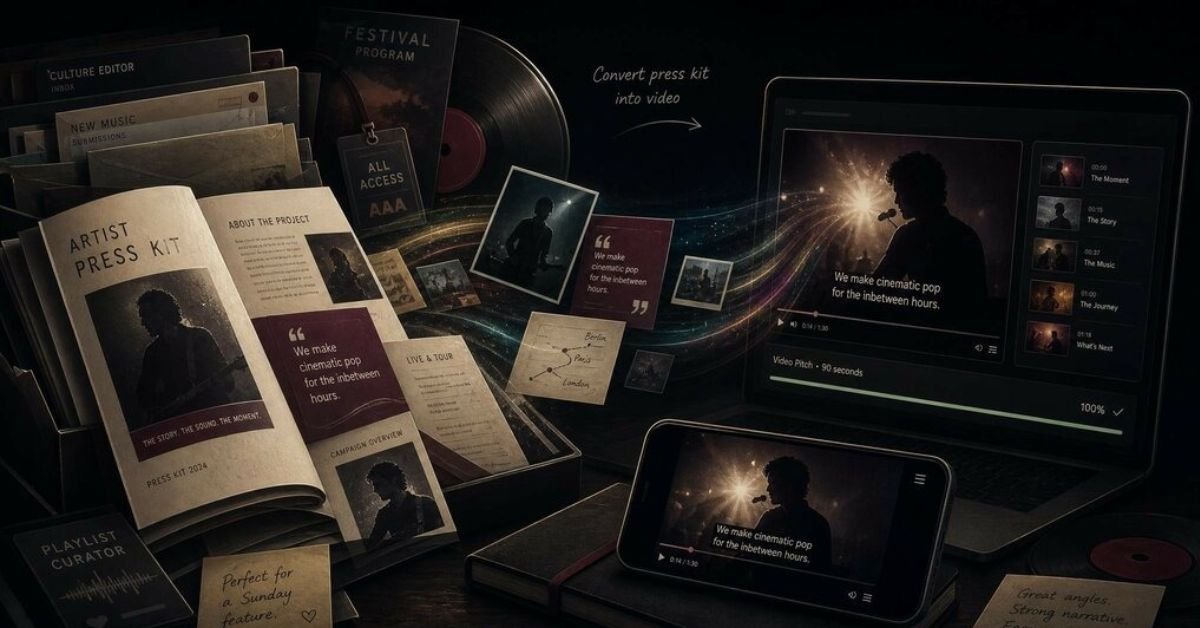
A publicist I know put a month into a single PDF: an artist’s press kit ahead of an album, the kind of thing a whole campaign hangs on. Bio, the story behind the record, hi-res photos, the three pull-quotes she wanted picked up, all of it laid out beautifully. She sent it to dozens of writers, playlist curators, and culture editors. Then she watched the coverage roll in — and almost all of it was paraphrased from the first page. The real story, the one three pages deep, never made it out.
This is the quiet failure mode of entertainment media. The material is strong, the design is clean, the angle is right there — and the people who decide whether your artist gets covered never make it past the opening paragraph.
It’s tempting to blame the writers. But that diagnosis misses the point. The kit was fine. The format was the bottleneck.
Related Stories



Why Strong Material Still Goes Unread
A dense PDF asks something specific of whoever opens it: sustained, uninterrupted attention to linear text, on a screen, during a workday already shattered by deadlines and notifications. Editors, curators, and bookers — the exact people a press kit exists to win — are the least able to give that. They’re not lazy. They’re buried, triaging dozens of pitches on a phone between other things, and a multi-page PDF is precisely the format that loses in those conditions.
So the kit gets opened, skimmed, and filed. What survives is a vague impression — “new record, sounds like the last one” — without the detail that would have made the coverage worth running. And here’s where it gets expensive: half-absorbed material doesn’t just fail to help, it distorts. When five writers each skim a different page, your artist ends up with five thin, non-overlapping versions of the story, and the angle you most wanted lands nowhere. The nuance you built — why this release matters, the quote that frames it, the context that makes it a story rather than an announcement — is the first thing to vanish.
The cost isn’t wasted design hours. It’s a campaign whose best material never reached the people it was built for, and a slow erosion of whether anyone opens what you send at all.
A Second Way to Consume the Same Material
The fix isn’t shorter press kits. It’s a second way to consume the same material — one that paces itself, carries emphasis through a narrated voice, and can be absorbed on a phone between meetings rather than demanding a clear half-hour. The obstacle was always production: narrating and editing a kit into video by hand is skilled work nobody on a small team has time for.
AI document-to-video tools have largely removed that overhead. A PDF video converter like Leadde.ai takes a source file — large kits and reports are supported — and produces a structured, narrated video rather than a flat read-aloud. The AI summarizes the key points, breaks the document into discrete scenes that map to its sections, and lays out on-screen text and subtitles, so each part of the kit becomes a paced, distinct segment a busy editor will actually finish — captions on for the many who watch on mute.
A few concrete places this earns its keep in entertainment and culture: turning an artist’s press kit or EPK into a ninety-second story that travels in a DM instead of dying in an inbox; turning a festival program or a year-end trend report into a watchable briefing for press and partners; and giving a long feature a video companion so the readers who’d never finish the piece still get the gist — and the byline.
Be honest about where it falls short, because treating it as more than a distribution aid invites disappointment. AI narration is good but can still read as subtly synthetic, and on-screen avatars look digital. Output tracks input closely — a rambling, poorly structured kit yields a rambling video. Heavy data tables, chart-dense industry decks, and intricate layouts translate poorly to a linear video; they were built to be studied, not narrated past. And the deep, brand-perfect polish a human production house delivers isn’t on the table here.
So keep the PDF as the record and the source of truth. The video is simply how the story gets into someone’s head before they decide whether to cover it. If your own open-and-read rates look like that publicist’s, the low-cost experiment is obvious: take one kit or report you know people meant to read, run it through a free tier, and watch whether they finish.

David Anderson is an entertainment and culture writer who covers celebrity news, film, television, and pop culture. His work focuses on accurate reporting, engaging storytelling, and delivering valuable insights to readers interested in the latest entertainment trends and industry developments.