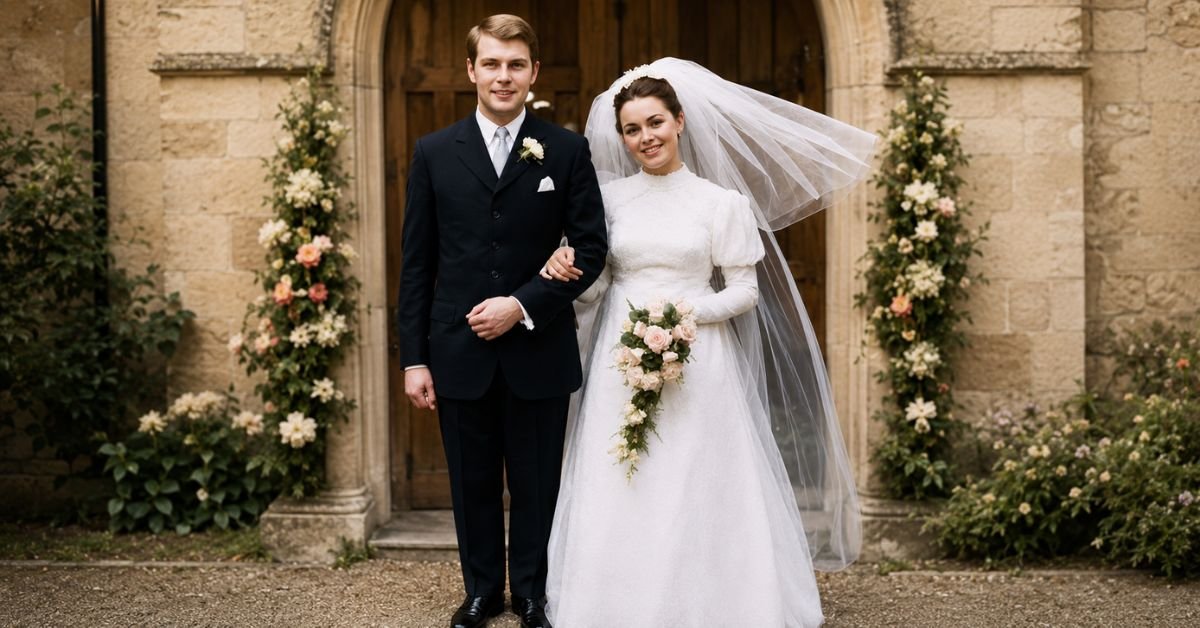
Quick answer: Sheila Buckley is a British woman best known as the parliamentary secretary, mistress, and eventual wife of Labour MP John Stonehouse — the politician who faked his own death in Miami in November 1974 and triggered one of the most extraordinary political and criminal scandals in modern British history.
There are political scandals, and then there is the story of John Stonehouse and Sheila Buckley. It has everything: a senior cabinet minister operating under a stolen identity, a vanishing act staged on a Miami beach, a transatlantic love affair conducted in secret, and a police investigation that accidentally intersected with the hunt for Lord Lucan. It is the kind of story that sounds invented. It wasn’t.
Sheila Buckley did not seek fame. She was not a politician, an actress, or a public figure in any conventional sense. She was a parliamentary secretary who fell in love with the wrong man at the wrong time — and found herself, quite suddenly, at the center of a story that gripped Britain for years. Then, just as suddenly, she stepped back into the shadows and largely stayed there.
Related Stories



Decades later, her name has resurfaced thanks to the 2023 ITV drama Stonehouse, which introduced a new generation to the scandal. And with that renewed attention comes a question that feels both entirely reasonable and oddly moving: who was Sheila Buckley, really?
Biography Snapshot
| Full Name | Sheila Buckley (later Sheila Buckley Stonehouse) |
| Known As | Sheila Buckley / Sheila Buckley Stonehouse |
| Date of Birth | Approximately 1946–1947 (not officially confirmed) |
| Age | Approximately 78–80 years old (as of 2026) |
| Birthplace | England, United Kingdom (specific location not publicly confirmed) |
| Nationality | British |
| Profession | Parliamentary Secretary; private individual |
| Years Active | 1970s (professionally) |
| Known For | Affair and marriage with MP John Stonehouse; role in the 1974 political and fraud scandal |
| Relationship Status | Widowed (John Stonehouse died in 1988) |
| Children | One son — James William John Stonehouse (born 1982) |
| Education | Not publicly confirmed |
| Net Worth | Not publicly confirmed; reported to reside in a £700,000 property in Romsey, Hampshire |
| Social Media | No verified public social media presence |
Early Life and Background
What do we know about Sheila Buckley’s early life?
Very little, as it turns out — and that absence is itself significant. Buckley was born in England, most likely around 1946 or 1947, based on age references made in press coverage during the 1970s. Beyond that, the public record is sparse.
She grew up during Britain’s postwar recovery, in an era when young women who sought professional employment typically pursued administrative or clerical work within government and public institutions. That path — steady, respectable, unremarkable — appears to be the one Buckley followed. There is no documented early ambition, no paper trail of public achievement, no education record that has entered the historical record.
This is not unusual for women of her background and generation. What it does mean, however, is that Sheila Buckley entered the historical record almost exclusively through her relationship with John Stonehouse. Everything that made her a public figure was tied to him. That dynamic — where a woman’s story is filtered entirely through a powerful man — shaped how she was seen during the scandal and how she continues to be remembered.
The Breakthrough Moment
What triggered the John Stonehouse and Sheila Buckley scandal?
On November 20, 1974, John Stonehouse walked into the sea at Miami Beach and never came back — at least, not as himself. He left his clothes folded neatly on the sand, a detail so deliberately theatrical that it almost felt like a dare. The world assumed he had drowned. His wife, Barbara, told reporters that all the evidence pointed to drowning.
He hadn’t drowned. He had fled.
Stonehouse — once tipped as a future prime minister, former Minister of Aviation, and final Postmaster General under Harold Wilson’s Labour government — had been stealing the identities of dead constituents. Inspired, reportedly, by Frederick Forsyth’s thriller The Day of the Jackal, he had obtained a passport in the name of Joseph Markham, a deceased man whose identity he had quietly appropriated, and used it to transfer money and book passage to Australia. His plan was to start over. And he intended to do it with Sheila Buckley.
The scheme unraveled spectacularly. Just over a month after his disappearance, Stonehouse was arrested in Melbourne — not because investigators had cracked the case, but because a bank teller grew suspicious of his transactions. Australian police, acting on an alert about Lord Lucan (the aristocratic murder suspect who had vanished twelve days before Stonehouse), ended up detaining the wrong missing man. The surreal comedy of the situation did nothing to soften its consequences. [Read more: The John Stonehouse Story — Rise, Fall, and Fraud]
Buckley, back in England, was now in the spotlight.
Career Evolution
How did Sheila Buckley’s role evolve from secretary to scandal figure?
Sheila Buckley’s professional life had brought her into close contact with one of the most ambitious men in British politics. As his parliamentary secretary, she handled correspondence, scheduling, and the day-to-day machinery of a busy political office. These were roles that required discretion, competence, and trust. She had all three.
What developed between them went beyond the professional, somewhere along the way. The affair was an open secret in some circles, though Stonehouse’s wife Barbara was reportedly unaware of its true nature until his arrest in Australia. [See also: Barbara Stonehouse — The Wife Left Behind]
When the scandal broke, Buckley’s role shifted from background participant to central character. Investigators examined not just Stonehouse’s actions but the extent to which she had been involved. She was charged in connection with the fraud — specifically, with counts relating to the conspiracy involving more than £170,000, including theft, forgery, and deception.
The charges transformed her public status in an instant. She went from being a private professional to being named in one of the most-followed criminal trials in British political history.
Most Iconic Works and Achievements
How has Sheila Buckley been represented in television and media?
Sheila Buckley herself has not pursued a public career, but her story has become the subject of significant media attention — most recently through the 2023 ITV drama Stonehouse, a three-part limited series that dramatized the events of 1974 and their aftermath. In the series, Buckley was portrayed by actress Emer Heatley, while Matthew Macfadyen (best known for his role as Tom Wambsgans in Succession) played John Stonehouse, and Keeley Hawes played Barbara Stonehouse. The real-life relationship between Macfadyen and Hawes, who are married, added an additional layer of intrigue to the casting.
The production aired on both ITV in the UK and BritBox for international audiences, drawing considerable attention and introducing the scandal to viewers who had never heard of it. Heatley, speaking about her portrayal of Buckley, described the challenge of playing someone whose inner motivations remain largely undocumented.
“There are definitely parts where you think ‘how could she possibly do that,'” Heatley said in an interview with uInterview, “but there are also moments where you see that there’s a real, genuine love and affection that she has for John to stick with him throughout all of this chaos.”
A companion ITV documentary, The Real Stonehouse, aired on January 5, 2023, and featured family members, former colleagues, and Australian police officers who had been involved in the original investigation. Buckley did not participate in the documentary — a decision consistent with the privacy she has maintained throughout her life.
Personal Life and Public Persona
What happened to Sheila Buckley after the trial?
The courtroom was where the most consequential chapter of Buckley’s public life concluded. In August 1976, following a 68-day trial, John Stonehouse was found guilty on multiple counts of theft, fraud, and deception. He was sentenced to seven years in prison and served three, being released in September 1978 for good behaviour.
Sheila Buckley received a two-year suspended sentence. The court’s treatment of her reflected a recognition that her role, while not trivial, was different in kind from Stonehouse’s. Metropolitan Police detective inspector David Townley, speaking in The Real Stonehouse documentary, offered an assessment that has since become one of the most quoted reflections on her situation.
“I thought she was polite — a kind, gentle person who’d been mesmerised by Stonehouse and dragged into something she shouldn’t have got involved in,” Townley said. “She ended up with two years in prison for being in love with someone. Stonehouse was a controlling person. She was young, attractive, and she clearly loved him very much.”
After Stonehouse’s release and divorce from Barbara in 1978, Buckley and Stonehouse married in 1981. The following year, she gave birth to their son, James William John. The couple had only a few years of married life together before Stonehouse died in 1988 following a heart attack, aged 62. He had suffered a series of cardiac episodes while in prison and had undergone open-heart surgery.
Widowed at approximately 41, Sheila Buckley raised their son largely outside of public view.
Hidden Facts and Lesser-Known Insights
What are the most surprising details about the Stonehouse scandal?
The Stonehouse case is dense with details that feel more like fiction than fact, and several of them directly touch on Buckley’s story.
The first is the Lord Lucan connection. Lord Lucan — the British aristocrat suspected of murdering his family’s nanny — disappeared on November 8, 1974, just twelve days before Stonehouse staged his fake death. When Australian police moved to investigate a suspicious man in Melbourne, they initially believed they might have found Lucan. They had, of course, found Stonehouse. The confusion is a remarkable footnote in both stories.
The second is the legal precedent. The 68-day trial produced what was, at the time, the longest dock statement in British legal history: Stonehouse spoke in his own defence for six days. The ancient right to make such a statement — without cross-examination — was subsequently abolished as a direct consequence of the proceedings.
Third, and perhaps most telling for understanding Buckley’s position: the inspiration for the scheme was a thriller novel. Stonehouse reportedly derived the idea of stealing a dead man’s identity from Frederick Forsyth’s The Day of the Jackal (1971). The gap between a plot device in a bestselling novel and the life of a real woman accused of conspiracy is not one that tends to be dwelt on in retellings of the case. [Explore: 1970s British Political Scandals That Shaped Modern Politics]
Net Worth and Business Influence
What is Sheila Buckley’s net worth and financial situation?
No verified figures on Sheila Buckley’s net worth have been reported or confirmed in public records, and any estimates circulating online should be treated with appropriate skepticism.
What has been reported — by the Daily Mail, as cited by multiple outlets — is that Buckley lives in a £700,000 detached home in Romsey, on the River Test in Hampshire. This detail offers a window into her current circumstances without providing a comprehensive financial picture.
She has not been publicly associated with any business activities, professional ventures, or commercial interests since the 1970s. Her financial situation appears to be that of a long-retired private individual, and there is no reliable basis for estimating figures beyond what has been specifically reported.
Fashion, Influence and Cultural Impact
What cultural legacy does Sheila Buckley’s story carry?
During the height of the scandal in the mid-1970s, press coverage of Buckley often focused as much on her appearance as on her role in events. She was described in contemporaneous reports as young, attractive, and glamorous — a brunette whose personal style attracted commentary that reflected the media conventions of the time, conventions that tended to emphasize the physical attributes of women at the center of male-dominated scandals.
That framing now reads as a marker of its era rather than a meaningful description. What Stonehouse (2023) attempted — with varying degrees of success — was to render her as a more fully realized person, motivated by genuine emotion rather than reduced to a shorthand for illicit romance.
The cultural impact of her story extends beyond its specific details. The Stonehouse case became a touchstone in discussions of political accountability, media ethics, and the way women adjacent to powerful men are treated by public institutions and the press. It has been referenced in academic writing on political scandal, and the 2023 drama renewed its place in the popular cultural conversation. [Related: The Real Stonehouse Documentary — What the Drama Left Out]
Social Media Presence
There are no verified social media accounts associated with Sheila Buckley on any platform, including Instagram, X (formerly Twitter), Facebook, or others. This is consistent with the private life she has maintained since the 1970s.
Any accounts claiming to represent her should be treated with significant caution and are not confirmed by any credible source.
Frequently Asked Questions
What is Sheila Buckley?
Sheila Buckley is a British woman who gained public attention as the parliamentary secretary and mistress of Labour MP John Stonehouse, who faked his own death in 1974. She received a two-year suspended sentence following the fraud trial, later married Stonehouse in 1981, and has lived privately since his death in 1988.
What happened to Sheila Buckley after the Stonehouse trial?
After receiving a suspended sentence in 1976, Buckley remained with John Stonehouse throughout his imprisonment. They married in 1981, and she gave birth to their son James William John in 1982. Following Stonehouse’s death in 1988, she has lived quietly in Hampshire, with no public appearances or media involvement reported.
Where does Sheila Buckley live now?
According to reporting by the Daily Mail, cited by multiple publications including The i Paper and Birmingham Live, Sheila Buckley lives in a £700,000 detached home in Romsey, Hampshire, on the River Test. She has maintained a very private life and rarely, if ever, speaks publicly about her past.
Who plays Sheila Buckley in the ITV drama Stonehouse?
Sheila Buckley is portrayed by actress Emer Heatley in the 2023 ITV limited series Stonehouse. The three-part drama also stars Matthew Macfadyen as John Stonehouse and Keeley Hawes as Barbara Stonehouse. The series aired on ITV in the UK and BritBox internationally.
Was Sheila Buckley convicted of a crime?
Sheila Buckley was charged in connection with John Stonehouse’s fraud scheme, facing counts related to a conspiracy involving more than £170,000. Following the 1976 trial, she received a two-year suspended sentence — meaning she did not serve time in prison. The court’s sentencing reflected the view that her involvement was significantly shaped by her relationship with Stonehouse.
A Life Beyond the Story That Defined Her
Sheila Buckley’s story is not a triumph narrative or a cautionary tale in the traditional sense. It is something rarer: an account of a private person who was pulled into an extraordinary situation, faced its consequences, and then — with quiet determination — built a life beyond it.
She could not control the headlines. She could not reshape how journalists wrote about her, or how courts assessed her involvement, or how dramatists would later interpret her motivations. What she could control was what came next: who she chose to remain with, how she raised her child, and whether she sought the spotlight or stepped away from it.
The renewed interest generated by the 2023 ITV drama has brought fresh attention to her name, and with it come the usual questions: What does she think of her portrayal? Does she regret her choices? Where is she now? She has, characteristically, not answered. That silence is its own kind of statement.
What the historical record does offer is a portrait of someone whose life was shaped by extraordinary circumstances — not because she sought them, but because she was caught in the wake of someone who did. The storm has long since passed. Sheila Buckley, now in her late seventies or early eighties, has apparently found something that eluded John Stonehouse entirely: a quiet life, on her own terms.

Emma Clarke is a content writer at Gaukurinn.is, specializing in celebrity news, pop culture, movies, and music. With a strong focus on accuracy and trending topics, she creates engaging and well-researched articles that keep readers informed and entertained.
Emma follows trusted sources and editorial standards to ensure content is reliable, relevant, and up to date. Her goal is to deliver clear, valuable information that readers can trust.