On June 13, 1980, a churchgoing Texas housewife named Candy Montgomery drove to a neighbor’s house to pick up a swimsuit. She left having struck her friend Betty Gore forty-one times with an axe. What followed — a landmark self-defense trial, a hypnosis-fueled acquittal, and decades of near-total anonymity — remains one of the most compelling true crime stories of the twentieth century. This article covers everything you need to know about Candy Montgomery today: who she is, what she did, how she walked free, and where she is now in 2026.
Candy Montgomery: Biography Snapshot
| Detail | Information |
|---|---|
| Full Name | Candace Lynn Montgomery (née Wheeler) |
| Known As | Candy Montgomery |
| Date of Birth | November 15, 1949 |
| Age (2026) | 76 years old |
| Birthplace | United States (exact city unconfirmed; reportedly met Pat Montgomery in El Paso, Texas) |
| Nationality | American |
| Profession | Homemaker (1970s–1980s); Mental Health Counselor (reportedly from 1996) |
| Years Active | Licensed therapist in Georgia from approximately 1996; license expired 2012 (per NBC News) |
| Known For | The 1980 killing of Betty Gore; self-defense acquittal; multiple television portrayals |
| Relationship Status | Divorced (from Pat Montgomery; divorced approximately 1984–1986) |
| Children | 2 (one son, one daughter) |
| Education | Returned to school in Georgia post-trial to study counseling |
| Net Worth | No verified figures available; estimated to be modest given reported counseling career |
| Social Media | No publicly known accounts; lives privately under maiden name |
| Current Name | Candace Wheeler |
| Current Location | Georgia (believed as of 2026) |
Early Life and Background
Candace Lynn Wheeler was born on November 15, 1949. She married Patrick “Pat” Montgomery in the early 1970s — reportedly just two months after they met — when she was working as a secretary and Pat was an engineer at Texas Instruments. By the accounts captured in John Bloom and Jim Atkinson’s 1984 book Evidence of Love: A True Story of Passion and Death in the Suburbs, theirs was a fast, optimistic union built on the promise of suburban comfort.
In 1977, the couple relocated to Collin County, Texas, settling just outside Dallas in the community around Wylie. They brought two children — a son and a daughter — and embedded themselves quickly in local life, joining the Methodist Church of Lucas. Candy taught Sunday school, sang in the choir, and by every visible measure lived the life of a devoted mother and wife. But according to Texas Monthly, she privately described herself as “bored crazy.”
Related Stories



That restlessness would become the fault line running beneath everything that followed.

The Affair with Allan Gore and the Killing of Betty Gore
How the Affair Began
At a church volleyball game, Candy Montgomery and Allan Gore — the husband of her close friend and fellow churchgoer Betty Gore — began spending more time together. Their flirtation escalated, and one evening at choir practice, Candy approached Allan directly. Their affair began physically on December 12, 1978. For several months, they met every other week, carefully, deliberately — conducting what Texas Monthly described as a meticulously planned extramarital arrangement.
The affair ended in 1979 when Allan chose to recommit to his marriage, particularly after Betty became pregnant. Candy agreed, and the relationship wound down without apparent incident. At least, that was how it appeared.
What Happened on June 13, 1980?
On a Friday morning, Candy drove to the Gores’ home in Wylie to collect a swimsuit for Alisa, the Gores’ older daughter, who was scheduled for a sleepover at the Montgomery house that evening. Allan was out of town on a business trip. Betty was home with their infant daughter, Bethany.
What began as small talk escalated quickly. Betty asked Candy directly whether she had been having an affair with her husband. Candy admitted it — but said it had ended “a long time ago,” according to her later courtroom testimony. Betty then walked into the utility room and returned carrying a three-foot wood-splitting axe. According to Montgomery’s account, Betty said, “You can’t have him, you can’t have him. I’ve got to kill you.”
A violent struggle followed. Candy eventually wrested the axe away. She struck Betty Gore forty-one times — forty of those blows while Betty’s heart was still beating, according to forensic testimony from expert Vincent DiMaio. Candy then left the house. Betty’s infant daughter Bethany remained alone in her crib for approximately thirteen hours before the body was discovered, after Allan — unable to reach his wife by phone — urged neighbors to investigate. The crime scene was so saturated with blood that local police initially speculated it was a copycat killing inspired by The Shining, released in theaters just three weeks earlier.
Candy Montgomery surrendered to authorities on June 26, 1980, and was charged with first-degree murder.
The Trial That Shocked Texas
Don Crowder, Robert Udashen, and the Self-Defense Strategy
Candy Montgomery was represented by civil law attorney Don Crowder — a fellow churchgoer who knew Candy personally — alongside criminal defense attorney Robert Udashen. A third attorney, Elaine Carpenter, also served on the defense team. The trial was held in McKinney, Texas, with District Judge Tom Ryan presiding. It lasted eight days.
The defense’s strategy hinged on self-defense. Montgomery took the stand in her own defense, maintaining that Betty Gore had come at her with the axe first, and that she had only acted to protect her own life. District Attorney Tom O’Connell pushed back hard, arguing that forty-one strikes went far beyond any reasonable act of self-defense — that Candy could simply have fled — and that the sheer ferocity of the attack demanded a murder conviction.
Before trial, Montgomery underwent a polygraph test. The results indicated she was being truthful.
The Hypnosis Sessions and the “Shh” Trigger
The most dramatic element of the defense came from psychiatrist Dr. Fred Fason, based in Houston’s River Oaks neighborhood. Udashen — acutely aware that the volume of blows would be difficult to explain to a jury — sought a psychiatric evaluation that could contextualize the rage behind them.
Under hypnosis, Dr. Fason used an age-regression technique to take Candy back through her memories. What emerged was a childhood hospital incident: a four-year-old Candy, hurt and frightened, being shushed harshly by her mother — not comforted, but silenced. “What will they think of you in the waiting room? Stop crying! Shhh!” According to Fason’s testimony, Betty Gore had used the same word — “shh” — during the confrontation, triggering what Fason described on the stand as a “dissociative reaction.” Montgomery, he argued, had emotionally walled herself off and acted out of decades of buried, unresolved rage — not premeditated murder.
The prosecution did not object to the hypnosis testimony, and Fason’s account went before the jury uncontested.
The Verdict
On October 30, 1980, after just over three hours of deliberation, a jury of nine women and three men found Candy Montgomery not guilty of murder. As she walked out of the courthouse, crowds chanted “Murderer! Murderer!” Betty Gore’s father, Bob Pomeroy, told reporters: “As far as I’m concerned, justice will be served. She has to live with it… I wouldn’t say I was happy with the verdict. We don’t know what happened and we never will know what happened.”
The hypnosis defense has remained controversial ever since. Writing for Texas Monthly, journalist Michael Hall noted that at least twenty-two U.S. states do not permit courtroom testimony from witnesses who have undergone hypnosis. Researchers including Binghamton University psychology professor Steve Lynn have consistently found that hypnosis does not reliably improve memory — and may actually introduce fabricated details. “Hypnosis is the junkiest of junk science,” Austin criminal justice researcher Scott Henson told Texas Monthly. Robert Udashen, the only surviving member of Candy’s legal team, maintains to this day that Dr. Fason conducted the sessions rigorously and that the testimony would still be admissible under properly drawn restrictions.
Television and Media Portrayals
Candy Montgomery’s story has proven irresistible to Hollywood — not once, not twice, but three times over more than three decades.
| Year | Title | Platform | Actress | Character Name | Awards/Notes |
|---|---|---|---|---|---|
| 1990 | A Killing in a Small Town | CBS | Barbara Hershey | Cathy Morrison (fictionalized) | Emmy Award; Golden Globe Award (Best Actress, Miniseries/TV Film) |
| 2022 | Candy | Hulu | Jessica Biel | Candy Montgomery | Melanie Lynskey as Betty Gore |
| 2023 | Love & Death | HBO Max (now Netflix) | Elizabeth Olsen | Candy Montgomery | Jesse Plemons as Pat; Lily Rabe as Betty Gore; Patrick Fugit as Pat |
Barbara Hershey became the first actor to bring the story to a wide audience. The 1990 CBS TV movie A Killing in a Small Town changed names and altered details for legal reasons, but the story was unmistakably that of Candy Montgomery. Hershey won both an Emmy Award and a Golden Globe for her portrayal — awards-season recognition that cemented the case’s cultural staying power.
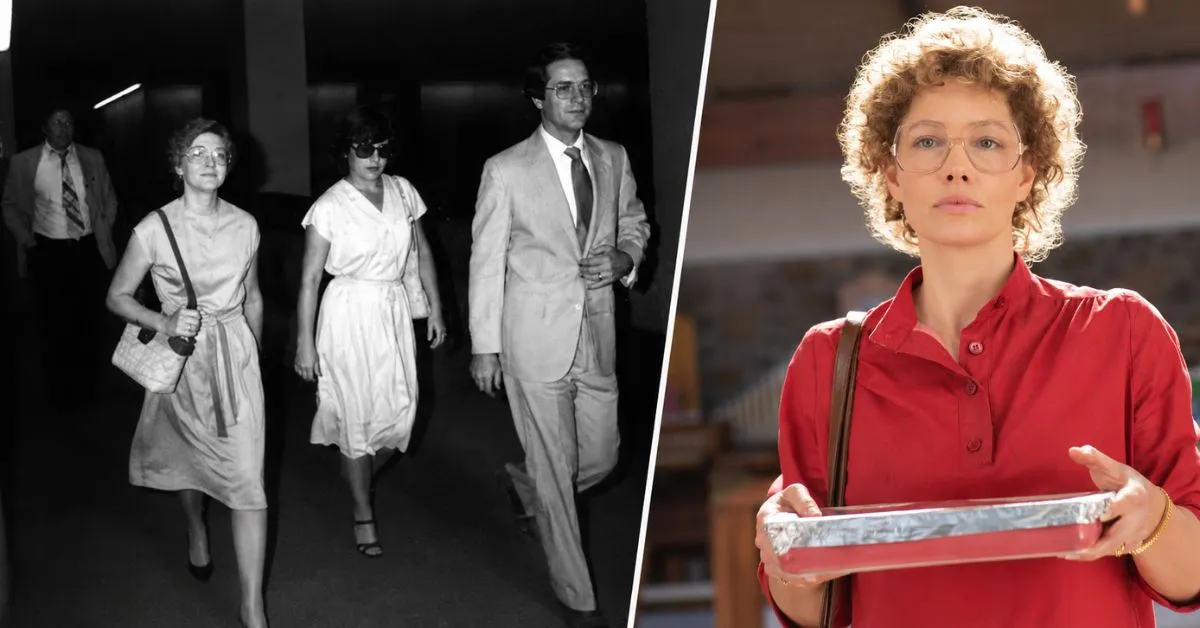
More than thirty years later, two competing productions arrived within a year of each other. Jessica Biel starred in Hulu’s Candy, which debuted in May 2022, with Yellowjackets star Melanie Lynskey as Betty Gore. Biel attempted to contact the real Candy Montgomery during production. According to Entertainment Weekly, Montgomery was “not interested.”
In April 2023, Elizabeth Olsen took on the same role in HBO Max’s Love & Death, a seven-episode limited series co-produced with Texas Monthly (which had originally broken the story in 1984) and based on both the magazine’s reporting and the Evidence of Love book by journalists John Bloom and Jim Atkinson. The series — featuring Jesse Plemons, Patrick Fugit, and Lily Rabe — is now available to stream on Netflix. The companion documentary Suburbia & Murder: Candy Montgomery was released by Max alongside the series. The case has also been the subject of an episode of Oxygen’s Snapped.
Personal Life: Marriage, Divorce, and the Quiet Years in Georgia
Pat and Candy Montgomery stayed together through the trial and its immediate aftermath. Within three months of the acquittal, the family quietly left Texas for Georgia — where Candy’s parents lived. They brought their two children with them and attempted to rebuild a normal life far from the glare of Wylie.
The marriage did not survive. Pat and Candy divorced approximately four to six years after the trial — reports vary between roughly 1984 and 1986. Pat Montgomery has since maintained a very low public profile; little has been reported about his life after the divorce.
Candy remained in Georgia. She reverted to her maiden name, Candace Wheeler, and has used it exclusively since. When the Dallas Morning News reached her in 2000 to discuss the twentieth anniversary of Betty Gore’s death, she responded with a single unambiguous statement: “I’m telling you in big bold letters: I’m not interested.”
According to reporting by NBC News, Montgomery obtained a therapist license in Georgia under the name Candace Wheeler, starting in 1996. That license expired in 2012. Multiple sources, including People magazine, report that she has worked as a mental health worker and counselor — and that she may work alongside her daughter. Betty Gore’s brother Ron Pomeroy, speaking to People Magazine Investigates, expressed disbelief: “The fact that she thought she could counsel after what she had done still boggles me to this day.”
The Lesser-Known Facts
The Candy Montgomery case is well-documented, but several details rarely make the headline summaries:
- The baby in the crib: Betty Gore’s infant daughter, Bethany, was alone in her crib for approximately thirteen hours before the body was discovered. She was awake, crying, and had been without care for the entire duration.
- The Shining connection: The crime scene was so extraordinarily bloody that Collin County Sheriff’s investigators initially theorized the killing might be a copycat crime inspired by Stanley Kubrick’s The Shining, which had been released in theaters just three weeks before Betty Gore’s death.
- The affair’s formal beginning: The affair between Candy Montgomery and Allan Gore did not begin impulsively. According to Texas Monthly, both parties discussed it explicitly before it started — even negotiating basic ground rules — and it began on a specific documented date: December 12, 1978.
- The polygraph: Before trial, Montgomery submitted to a polygraph examination. The results indicated she was telling the truth.
- Forty of the forty-one strikes: Forensic expert Vincent DiMaio testified that forty of the forty-one axe blows were delivered while Betty Gore’s heart was still beating.
- The hypnosis debate: Dr. Fason’s hypnosis sessions were tape-recorded, and Candy had provided a written narrative before the sessions began. Udashen argues this made the process more rigorous than most forensic hypnosis of the era. Critics, including researchers published in the American Psychological Association’s bulletin, note that age regression under hypnosis has no reliable scientific basis.
- Don Crowder’s personal connection: Candy’s lead attorney, Don Crowder, was not a criminal defense lawyer by training — he was a civil law attorney who knew Candy through their shared church. His determination to defend her, and his instinct to bring in Dr. Fason, shaped the entire outcome of the trial.
Cultural Impact and True Crime Legacy
Candy Montgomery’s story crystallized something specific about American suburban anxiety that has only grown more resonant with time. Here was a woman who attended church, taught Sunday school, baked casseroles, raised her children — and committed an act of extraordinary violence, walked free, and quietly resumed a life somewhere just out of view.
The case arrived at a pivotal moment in American cultural history. The 1980s suburban ideal — the immaculate lawns, the church socials, the carefully managed surfaces — was already beginning to crack under scrutiny. Candy Montgomery became a lightning rod for every unasked question about what lies beneath respectability. Was she a calculating killer? A traumatized woman pushed past a breaking point? An ordinary person who snapped under extraordinary circumstances? The jury said not guilty. The public was never quite so sure.
The simultaneous release of two competing prestige TV productions in 2022 and 2023 confirmed that her story has never stopped compelling audiences. Both the Candy Hulu series and HBO Max’s Love & Death debuted to significant viewership and critical attention, with Elizabeth Olsen’s performance in the latter earning particular praise. The companion Suburbia & Murder documentary extended the conversation further.
Her story endures not because the facts are uniquely grim — true crime offers no shortage of those — but because the questions it raises remain stubbornly open. Candy Montgomery lives in Georgia now, under a name most people would not recognize, reportedly helping others navigate their mental health. Whether you find that ironic, admirable, or deeply unsettling says as much about you as it does about her.
Where Is Candy Montgomery Now in 2026?
As of 2026, Candy Montgomery — now 76 years old and living as Candace Wheeler — is believed to still reside in Georgia. She has consistently refused media requests for comment, declining interviews with the Dallas Morning News, declining to participate in Jessica Biel’s Hulu series, and declining, as far as can be determined, every subsequent approach.
Her therapist license, obtained under her maiden name in Georgia starting in 1996, expired in 2012 according to records obtained by NBC News. Whether she continued working in the mental health field after that point is not publicly confirmed. Some reports suggest she may work alongside her daughter.
She has no known social media presence. She does not give interviews. She has, to every visible degree, made good on the desire she expressed to reporters the day she walked out of that McKinney courthouse in October 1980: to “get all this behind me and be normal again.”
Betty Gore’s daughters, Alisa and Bethany — raised by Betty’s parents, Bob and Bertha Pomeroy, in Norwich, Kansas — are now adults with their own professional lives and families, according to People Magazine Investigates.
The Story That Won’t Quietly Go Away
Candy Montgomery has done everything possible to disappear. She changed her name, changed her state, changed her profession, and refused to engage with the media coverage that has pursued her story for over four decades. And yet here we are, in 2026, still reading about her — and so, in all likelihood, are millions of others watching Elizabeth Olsen’s performance on Netflix or revisiting Jessica Biel’s portrayal on Hulu.
The case endures because it poses a genuinely uncomfortable question: what do we do with a verdict we cannot reconcile with our instincts? Forty-one strikes is not a number that sits quietly in the mind. The jury deliberated for just over three hours and said not guilty. Crowds outside the courthouse said murderer. The law and the gut have not agreed on Candy Montgomery for forty-six years.
If you’re exploring the intersection of true crime, American suburban culture, and the limits of the legal system, the book Evidence of Love by John Bloom and Jim Atkinson remains the definitive primary account — sharp, reported, and written before the story became a prestige television property. Both Candy on Hulu and Love & Death on Netflix offer absorbing, well-acted dramatizations worth your time, though neither claims to have the final word.
Nobody does.
Frequently Asked Questions
Who is Candy Montgomery?
Candy Montgomery — real name Candace Lynn Montgomery, née Wheeler — is an American woman who, on June 13, 1980, killed her friend Betty Gore with an axe in Wylie, Texas. At the time, Montgomery was a 30-year-old suburban homemaker and churchgoer who had previously conducted a months-long extramarital affair with Betty’s husband, Allan Gore. Montgomery was charged with first-degree murder, pleaded not guilty on self-defense grounds, and was acquitted on October 30, 1980, after an eight-day trial in McKinney, Texas.
Where is Candy Montgomery now in 2026?
As of 2026, Candy Montgomery is believed to be living in Georgia, where she has resided since moving there approximately three months after her 1980 acquittal. She goes by her maiden name, Candace Wheeler. NBC News reported that she held a therapist license in Georgia from approximately 1996, which expired in 2012. She is reportedly 76 years old and has consistently declined media interviews and public appearances. She has no verified social media presence.
Did Candy Montgomery go to jail?
No. Candy Montgomery did not go to jail. She was found not guilty of first-degree murder on October 30, 1980, by a jury of nine women and three men who deliberated for just over three hours. Her defense team — led by attorneys Don Crowder and Robert Udashen — successfully argued self-defense, supported by psychiatric testimony from Dr. Fred Fason regarding a hypnosis-revealed childhood trauma and a resulting dissociative reaction.
Who played Candy Montgomery on television?
Three actors have portrayed Candy Montgomery across different adaptations. Barbara Hershey played a fictionalized version of Montgomery in the 1990 CBS TV movie A Killing in a Small Town, winning both an Emmy Award and a Golden Globe for the role. Jessica Biel starred as Montgomery in Hulu’s 2022 miniseries Candy. Elizabeth Olsen portrayed Montgomery in HBO Max’s 2023 series Love & Death, which is now available to stream on Netflix.
What happened to Candy Montgomery’s children?
Candy Montgomery and her ex-husband Pat Montgomery have two children — a son and a daughter. After the trial, the family relocated to Georgia, where Candy’s parents lived. Pat and Candy subsequently divorced, approximately four to six years after the acquittal. The children have maintained very private lives. Some reports suggest that Candy’s daughter may work alongside her mother in a professional capacity in Georgia, though this has not been officially confirmed.

Emma Clarke is a content writer at Gaukurinn.is, specializing in celebrity news, pop culture, movies, and music. With a strong focus on accuracy and trending topics, she creates engaging and well-researched articles that keep readers informed and entertained.
Emma follows trusted sources and editorial standards to ensure content is reliable, relevant, and up to date. Her goal is to deliver clear, valuable information that readers can trust.