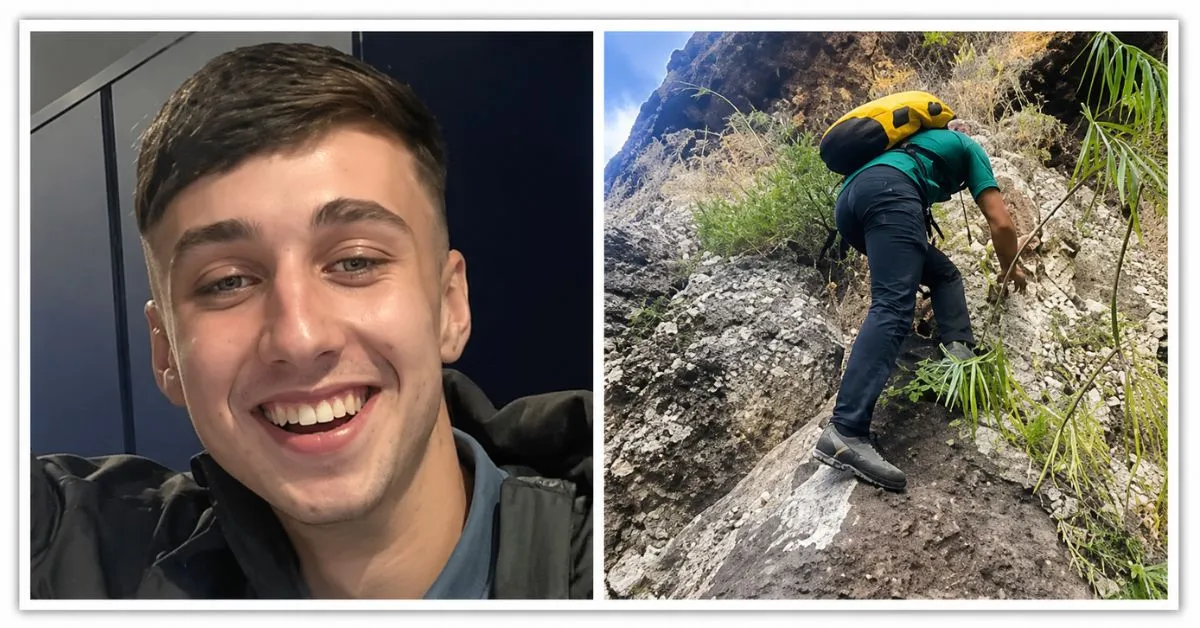
Quick answer: Jay Slater was a 19-year-old British apprentice bricklayer from Oswaldtwistle, Lancashire, who vanished in Tenerife in June 2024 after a music festival. His body was found 29 days later in a remote ravine. In July 2025, a coroner ruled his death an accidental fall, with no third-party involvement.
For 29 days in the summer of 2024, the world held its breath over a teenager from a small Lancashire town. Jay Slater had flown to Tenerife for his first holiday with friends—a rite of passage, a few sun-soaked days of music and freedom. He never came home.
What followed was one of the most closely watched missing-person sagas in recent British memory. Helicopters scoured volcanic ravines. TikTok detectives spun theories by the hour. A grieving mother boarded a plane into the unknown. And when the truth finally emerged, it was both heartbreakingly simple and deeply human.
Related Stories



This is the full story of what happened to Jay Slater—the disappearance, the search, the discovery, and the inquest that, more than a year later, gave his family the answers they had begged for. It is told with care, because at the center of every headline was a real young man, loved by many, gone far too soon.
Jay Slater at a Glance
| Detail | Information |
|---|---|
| Full name | Jay Dean Slater |
| Born | 26 April 2005 |
| Died | 17 June 2024 (aged 19) |
| Hometown | Oswaldtwistle, Lancashire, England |
| Occupation | Apprentice bricklayer |
| Place of death | Juan López ravine, Buenavista del Norte, Tenerife |
| Cause of death | Traumatic head injuries from a fall (accidental) |
| Inquest verdict | Accidental death, no third-party involvement (July 2025) |
Who Was Jay Slater? Early Life and Background
Jay Slater was a 19-year-old apprentice bricklayer from Oswaldtwistle, a town in Lancashire, England. Friends and family described him as warm, funny, and endlessly sociable.
Born on 26 April 2005, Jay was, in the words of his mother Debbie Duncan, “a bundle of fun with a constant smile.” She told his inquest that he “always made new friends wherever he went” and had “a large circle of good friends who have been left devastated at his tragic death.”
That detail matters. Jay wasn’t a loner who wandered off alone. He was the opposite—a young man drawn to people, to laughter, to the next good time. The trip to Tenerife in June 2024 was meant to be exactly that: a celebration with mates, his first holiday away without family. It’s the kind of trip thousands of British teenagers take every summer without a second thought.

What Happened to Jay Slater in Tenerife?
Jay Slater went missing on 17 June 2024 after attending the NRG music festival in Playa de las Américas, then traveling to a remote Airbnb roughly 22 miles away. He set off to walk back alone, became lost in the mountains, and was never seen alive again.
The timeline, pieced together at his inquest, reads like a series of small decisions that compounded into tragedy.
On 16 June, Jay attended the NRG festival in southern Tenerife. When his friends decided to call it a night, Jay wanted to keep going. According to his friend Bradley Geoghegan, Jay had taken ecstasy and cocaine, and possibly ketamine, across the night. At one point he was refused entry to the Papagayo nightclub—a text claimed it was because they “had a mark on him,” though Geoghegan clarified the real reason was simpler: Jay “couldn’t stand up.”
In the early hours of 17 June, Jay separated from his group. He climbed into a car with two men he’d met on holiday and was driven to an Airbnb in the remote village of Masca, about 22 miles (36km) from his accommodation. His friend Geoghegan suspected Jay “probably got there and thought, ‘Why am I here?’ sobered up and decided to come back.”
Rather than wait for a lift offered the following afternoon, Jay chose to walk—a journey of roughly 14 hours through unforgiving mountain terrain.
The last person to speak with him was Lucy Law, a friend of six years. In a final phone call lasting just 22 seconds, Jay told her he had missed a bus, was lost “in the middle of the mountains,” needed water, and had only 1% battery left. There was, he said, “literally nothing” around him. Then the line cut out—possibly because the dying phone simply gave up. Law, panicking, urged him to turn back.
He never did.
The Search for Jay Slater
The search for Jay Slater lasted 29 days and became one of the largest missing-person operations in recent memory, involving Spanish police, mountain rescue teams, helicopters, drones, sniffer dogs, and hundreds of volunteers.
Jay was reported missing to Spanish police on 18 June. His mother and brother boarded a flight to Tenerife almost immediately, stepping into a nightmare that would play out under the glare of the world’s media.
Investigators had an approximate location to work from—the Rural de Teno park—because Jay’s phone had pinged off a nearby mast before going dark. But “approximate” meant little in a landscape of steep ravines, sheer cliffs, and vegetation so dense that crews had to hack through it with machetes.
Spanish authorities deployed helicopter crews, specially trained search dogs, and drones across the brutal terrain. Jay’s friends and family searched alongside them. The effort drew international volunteers, amateur investigators, and a tidal wave of online speculation that, at times, made the genuine work of finding him harder.
Day after day passed with no sign. Hope frayed.
Jay Slater Found: The Discovery
Jay Slater was found dead on 15 July 2024 in the treacherous Juan López ravine near Masca, after mountain rescue teams searched a little-used, waterless area of the Rural de Teno park.
It was there, in one of the most inaccessible stretches of the landscape, that searchers finally found him. Around 66 feet (20m) above his body, they discovered his bag, containing his phone and gas canisters.
The Spanish report painted a quietly devastating picture. The sea was visible from the head of the ravine, and authorities suggested Jay may have believed he could climb down toward a beach and find help. “It would be easy to slip on the rocks and fall into the void,” their report noted. They could not explain why he “took a chance” by leaving the road—only that, exhausted and disoriented, he had.
His identity was confirmed through fingerprint testing by Spanish police and the Canary Islands Higher Court of Justice. An iPhone 14 found on the body was confirmed as his by the linked phone number and email address.
How Did Jay Slater Die? Cause of Death and Autopsy
Jay Slater died from traumatic head injuries sustained in a fall of approximately 20 to 25 meters. He suffered skull fractures and brain trauma, and the coroner concluded death was instantaneous.
A preliminary Spanish post-mortem examination recorded the death as “violent,” with the immediate cause being “traumatic shock.” The findings were stark but, in one sense, merciful.
The fall fractured Jay’s skull and caused non-survivable brain injuries—damage so severe that even immediate medical attention could not have saved him. He also sustained fractures to his pelvis in multiple places. His injuries were entirely consistent with a fall onto rocky ground from height.
Coroner Dr. James Adeley offered the family what little comfort the facts allowed: Jay would not have suffered. The coroner said he hoped it was “of some consolation to the family” that Jay would not have been in pain.
The Jay Slater Inquest: What the Coroner Concluded
At the Jay Slater inquest, coroner Dr. James Adeley ruled in July 2025 that “Jay Dean Slater died an accidental death” without any third-party involvement, after a fall in a “particularly dangerous area.”
The inquest, held at Preston Coroner’s Court, was anything but straightforward. It opened in May 2025 but was adjourned after a heartfelt plea from Jay’s mother, Debbie Duncan, who asked that key witnesses present on the night her son vanished be compelled to attend.
Even then, the court could not locate two men, Brandon Hodgson and Stephen Roccas, who had been with Jay before he disappeared. Their absence fueled lingering questions—but the evidence the coroner did gather pointed firmly in one direction.
Detective Chief Inspector Rachel Higson of Lancashire Police analyzed Jay’s iPhone. Some messages had been lost because various accounts were blocked across social media platforms—something the coroner stressed was “not a criticism or any form of censure,” simply an explanation of why some data couldn’t be interpreted.
Dr. Adeley identified several contributing factors to the fatal fall: a lack of suitable clothing, lack of sleep, no mountain training, and the potential after-effects of the drugs Jay had taken. Crucially, he found “every indication Jay’s friends were concerned about him” and had “made efforts to find him and persuade him to return”—singling out Lucy Law’s repeated attempts to reach him.
“As Jay is an adult, he has every right to ignore such concerns and to make his own decisions,” the coroner said. It was a sober reminder that this was a tragedy, not a crime.
Public Response and Media Coverage
Jay Slater’s disappearance triggered an extraordinary public response, blending genuine community support with rampant online speculation and conspiracy theories that often outpaced the facts.
The case became a global phenomenon. A fundraising page set up by Lucy Law drew significant donations to support the search and Jay’s family. Volunteers flew in to help comb the terrain. But the same intense interest had a darker side.
Social media—particularly TikTok—filled with armchair investigators, wild theories, and misinformation. Some speculation was so persistent that it distracted from, and at times hindered, the official search. For a family already enduring the unimaginable, the noise added cruelty to grief.
That tension—between a community wanting to help and an internet hungry for content—became one of the defining features of the Jay Slater story, and a cautionary tale about how modern tragedies unfold in public.
The Disappearance of Jay Slater: The Documentary
A Channel 4 documentary titled The Disappearance of Jay Slater, produced by Candour Productions, explored the case, the search, and the swirl of online speculation surrounding the teenager’s death.
The documentary examined how a personal tragedy became a viral spectacle, and how the relentless churn of online theories affected the investigation and the family. It stands among the more substantial media treatments of the case, offering a fuller, more responsible account than the fragmented speculation that dominated social feeds during the search itself.
Hidden Facts and Lesser-Known Insights
Several details from Jay Slater’s case received less attention than the headlines but help complete the picture:
- The 22-second final call. Jay’s last known communication—his phone call with Lucy Law—lasted just 22 seconds before cutting off, likely because his battery had drained to 1%.
- The bag above the body. Searchers found Jay’s bag, containing his phone and gas canisters, roughly 66 feet above where his body lay—evidence of how far he fell.
- A lift was waiting. Jay had been offered a ride back to his accommodation the following afternoon. He chose instead to attempt a 14-hour walk through the mountains.
- The pull of the sea. Investigators believe Jay may have left the safety of the road because he could see the ocean and thought he could reach a beach for help.
- Lost digital data. Some of Jay’s messages were unrecoverable because accounts had been blocked across social media—a small but telling complication in piecing together his final hours.
Frequently Asked Questions
What is Jay Slater?
Jay Slater was a 19-year-old British apprentice bricklayer from Oswaldtwistle, Lancashire, who disappeared in Tenerife in June 2024 and was later found dead in a remote ravine. His case drew worldwide attention.
How did Jay Slater die?
Jay Slater died from traumatic head injuries after an accidental fall of roughly 20 to 25 meters in the Juan López ravine. He suffered skull fractures and brain trauma, and death was instantaneous.
Was Jay Slater’s death suspicious?
No. In July 2025, coroner Dr. James Adeley ruled Jay Slater’s death an accidental fall with no third-party involvement, despite intense online speculation suggesting otherwise.
When was Jay Slater found?
Jay Slater’s body was found on 15 July 2024, 29 days after he went missing, in the treacherous Juan López ravine near the village of Masca in Tenerife’s Rural de Teno park.
Is there a Jay Slater documentary?
Yes. Channel 4 aired The Disappearance of Jay Slater, produced by Candour Productions, examining his disappearance, the search effort, and the online frenzy that surrounded the case.
Remembering Jay Slater
In the end, the story of Jay Slater was not a mystery of villains and cover-ups, however much the internet wished it to be. It was the story of a 19-year-old who made a series of small, fateful choices on an unfamiliar mountain at night—and a family who refused to stop searching for answers until they had them.
The inquest gave Debbie Duncan and her family a measure of closure: their son’s death was a tragic accident, his friends did try to help him, and he did not suffer. It cannot give them back the young man with the constant smile. “Our lives will never be the same without Jay,” his mother said.
Jay’s story is a quiet warning, too—about unfamiliar terrain, about phones that die at the worst moments, and about the speed at which real grief can be swallowed by online spectacle. If there’s anything to carry from it, perhaps it’s compassion: for the family who lived this in public, and for the memory of a young man who deserved to come home.

Emma Clarke is a content writer at Gaukurinn.is, specializing in celebrity news, pop culture, movies, and music. With a strong focus on accuracy and trending topics, she creates engaging and well-researched articles that keep readers informed and entertained.
Emma follows trusted sources and editorial standards to ensure content is reliable, relevant, and up to date. Her goal is to deliver clear, valuable information that readers can trust.