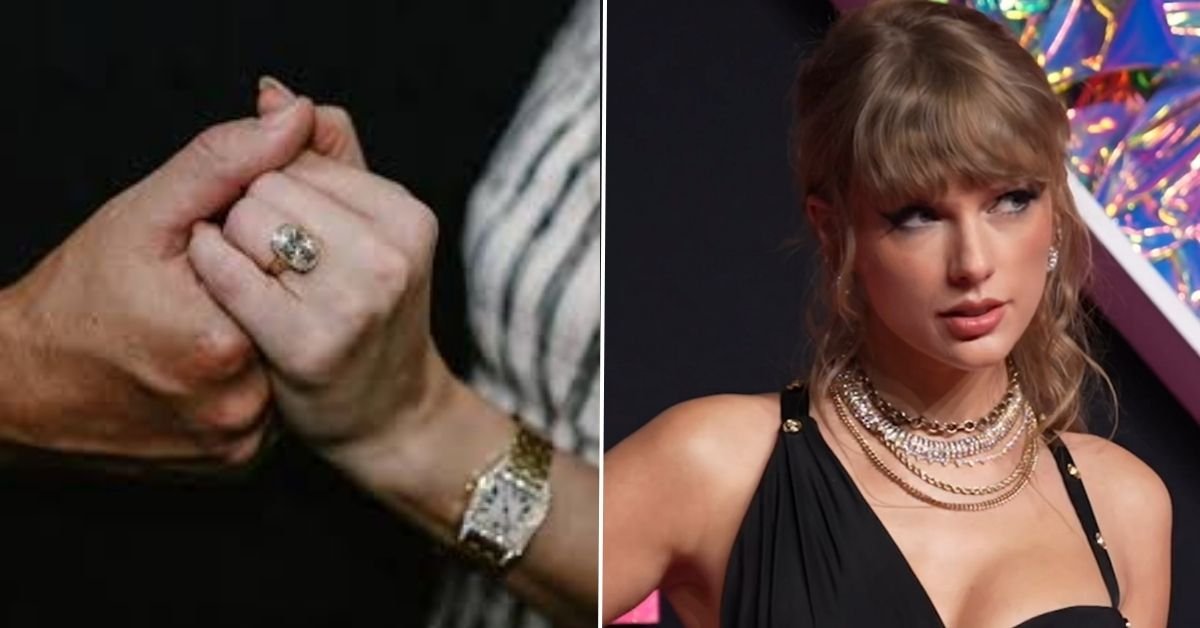
When Taylor Swift posted a carousel of engagement photos on August 26, 2025 — captioned “Your English teacher and your gym teacher are getting married” — 37 million likes piled up in days. But while the world was focused on the flower-filled proposal setting and the couple’s matching grins, jewelers and gemologists were zoomed in on something else entirely: the ring on her left hand.
Travis Kelce didn’t walk into a chain jeweler and pick the biggest oval on display. He went to a small, New York City–based goldsmith named Kindred Lubeck, helped design a custom ring featuring an antique diamond cut most people had never heard of, and set it in warm yellow gold at a time when platinum and white gold still dominated the market. The result was a ring that felt less like a celebrity flex and more like a love letter — to Taylor’s vintage-leaning aesthetic, to craftsmanship over mass production, and to the idea that engagement rings should tell a story.
This guide covers every confirmed and expert-verified detail about the ring itself, the designer behind it, how much it likely cost, and why it has already reshaped engagement ring trends heading into 2026 and beyond.
Related Stories

What Does Taylor Swift’s Engagement Ring Look Like?
The Diamond: An Old Mine Brilliant Cut
The centerpiece of Taylor’s ring is an elongated cushion-shaped old mine brilliant-cut diamond, set with four prongs and a low-profile bezel. Old mine cuts are antique diamonds that predate modern cutting techniques — they were hand-cut and hand-polished during the 18th and 19th centuries, primarily during the Georgian and Victorian eras.
What makes them visually distinct from a modern cushion cut:
- High crown and large, open facets that produce broad flashes of light rather than the “splinterly” sparkle of modern brilliants
- A visible open culet — the small polished flat at the bottom of the stone that looks like a tiny window when viewed from above
- Slightly irregular symmetry, because each stone was shaped by hand rather than laser-cut to mathematical precision
- A warmer color tone, often in the I–K range on the diamond color scale, which looks intentional and romantic rather than “off-white”
Old mine cuts were designed to sparkle under candlelight, not fluorescent store lighting. The effect is softer, more mysterious, and deeply romantic — a poetic match for a songwriter whose entire catalog mines themes of nostalgia, memory, and the passage of time.
The Setting: 18-Karat Yellow Gold
The diamond sits in an 18-karat yellow gold band with hand engraving and smaller bezel-set accent diamonds along the shank. Multiple experts have described the setting as Georgian-inspired, with a chunky, sculptural profile that sits low on the finger.
Yellow gold had been making a comeback for several years before the Swift-Kelce engagement, but this ring accelerated the trend significantly. Yellow gold complements the naturally warm undertones of an antique diamond far better than platinum or white gold, which can make older stones appear slightly yellow by contrast.
The Band and Details
The band itself features Kindred Lubeck’s signature hand engraving — every design element carved into the metal by hand rather than machine-stamped. Reports also point to a split shank or looped detail near the gallery (the underside of the setting), adding visual depth from every angle.
How Many Carats Is Taylor Swift’s Ring?
Since neither Swift, Kelce, nor Lubeck has officially disclosed the diamond’s exact specifications, everything known comes from expert analysis of photographs. The estimates from credentialed gemologists and jewelry professionals break down as follows:
| Source | Estimated Carat Weight |
|---|---|
| Stephanie Gottlieb Fine Jewelry (for NBC News) | 8–10 carats |
| The Hollywood Reporter (three-expert panel) | ~10 carats |
| Hannah Florman, jeweler (for TODAY) | ~8 carats |
| Simone Kendle, CEO of Wove Made Inc. (for TODAY) | 7–8 carats |
| Lauren B Jewelry | 7–8 carats |
| The Clear Cut (via TikTok) | 4–7 carats |
| Fox Business (citing Mike Seliktar) | 8–15 carats |
| Queensmith gemmologists | 8–10 carats |
The consensus range is approximately 7 to 10 carats, with the majority of experts clustering around 8 to 10 carats. The wide variation is partly because old mine cuts have different proportions than modern stones — their high crowns and deep pavilions mean they can “face up” smaller or larger than their actual weight depending on the individual stone’s dimensions.
One common point of agreement: the stone appears to be what gemologists call a “spready” diamond — one that maximizes visual size relative to its carat weight — which makes precise estimation from photos especially tricky.
How Much Is Taylor Swift’s Engagement Ring Worth?
The valuation range is broad because quality variables like exact color grade, clarity, and the rarity of the specific antique stone are impossible to determine from photographs alone.
| Source | Estimated Value |
|---|---|
| Austin Willard, Faithful Platform Fine Jewelry | $400,000–$1.2 million |
| David Steinmetz, diamond dealer | ~$800,000 |
| Laura Taylor, Laurel Diamonds | $675,000–$1 million |
| Hannah Florman, jeweler | $500,000–$1 million |
| Fox Business | ~$550,000 |
| Queensmith (UK) | £500,000–£600,000 (~$670,000–$800,000) |
| People Magazine (citing experts) | $3.5 million–$5 million |
Most credible, middle-ground estimates place the ring’s total value somewhere between $500,000 and $1.2 million. The outlier estimates toward $3–5 million likely factor in either a higher carat weight assumption, exceptional color/clarity, or the “provenance premium” that attaches to antique stones with documented histories.
Key pricing factors for old mine cut diamonds specifically:
- Rarity: Genuine antique stones from the 18th–19th century can’t be reproduced. The supply is fixed.
- Color warmth: While warmer color is typically a negative in modern diamond pricing, it’s expected and even desirable in antique cuts.
- Clarity characteristics: Antique diamonds often have inclusions that add character. A “perfect” old mine cut is almost a contradiction in terms.
- Craftsmanship premium: Lubeck’s hand engraving and the custom nature of the ring add significant value beyond the stone.
Who Designed the Ring? Meet Kindred Lubeck
Kindred Lubeck is a New York City–based goldsmith and the founder of Artifex Fine Jewelry. Before the Swift-Kelce engagement, she was known within a small circle of jewelry insiders for her handcrafted, vintage-inspired pieces — particularly her hand engraving, a painstaking technique where every decorative line is carved directly into the metal with hand tools rather than being cast from a mold or etched by machine.
How Kelce Found Lubeck
Swift herself explained the backstory during an appearance on Heart Breakfast (hosted by Emma Bunton and Jamie Theakston). She had shown Kelce pieces by Lubeck in the past and expressed how much she loved the designer’s work. When he decided to propose, he remembered — and went directly to Lubeck to collaborate on a custom design.
When Swift saw the ring, she immediately recognized the maker. As she put it on Heart Breakfast: she gasped and knew exactly who had created it. The fact that Kelce paid that kind of attention — remembering a passing comment about a relatively niche jewelry designer — became part of the ring’s romantic story.
Artifex Bridal: Lubeck’s New Collection
The engagement catapulted Lubeck to international fame practically overnight. Her waitlist for custom work became unmanageable (she was previously producing only about 10 rings per year), and in April 2026, she announced Artifex Bridal by Kindred Lubeck — a limited-edition collection of engagement rings, wedding bands, and bridal jewelry.
The first drop on April 10, 2026 included approximately 25 pieces, with plans for quarterly releases of similar size. Key pieces in the inaugural collection:
- Diamond engagement rings with Lubeck’s signature hand engraving
- A channel-set baguette wedding band with milgrain border
- A tennis bracelet featuring a hand-engraved sunburst motif and invisible clasp
- A 3.63-carat old mine diamond ring with an engraved halo and looped band detail
Every single ring is unique. Lubeck personally selects each stone, then passes it to a jeweler she has trained in her specific hand-engraving technique. As she told Vogue: she’s not interested in replicating designs fully — no two customers should meet someone wearing the exact same ring.
Taylor’s particular ring, however, will never be recreated for anyone else.
The “Taylor Swift Effect” on Engagement Ring Trends
Taylor Swift doesn’t just move the culture through music. The engagement ring she revealed in August 2025 has had measurable, documented effects on jewelry buying behavior and design trends heading into 2026.
Old Mine Cuts Go Mainstream
Before the Swift-Kelce engagement, old mine cut diamonds were a niche interest — sought after by antique jewelry collectors and a small subset of brides who already knew they wanted something different. After August 2025, the search volume for “old mine cut engagement ring” surged dramatically.
Multiple industry reports now list old mine cuts among the top engagement ring trends for 2026. VRAI, Brilliant Earth, and Modern Gents have all cited renewed interest in antique and vintage-inspired cuts, with Swift’s ring frequently named as the catalyst.
Jeweler Andria Barboné, who specializes in old mine cut styles, has noted that antique and old mine cut diamonds generally date from before the 1940s and have broader, more open facets compared to the look of modern diamonds, as well as a more open culet.
Yellow Gold’s Full Comeback
Yellow gold had been trending upward for a few years, but the Swift ring gave the metal type its most high-profile celebrity endorsement in recent memory. Jewelers report that yellow gold requests have increased noticeably for engagement settings, particularly when paired with warm-toned or antique stones.
Character Over Perfection
Perhaps the most significant cultural shift is attitudinal. In an era when lab-grown diamonds have made large, “perfect” stones accessible at a fraction of the cost of natural diamonds, Swift’s ring represents a deliberate choice of character over precision. The diamond is hand-cut, slightly irregular, warm in color, and glows softly rather than blasting light in every direction.
This aligns with a broader 2026 trend that multiple industry analysts have identified: couples are prioritizing individuality, heritage, and personal meaning over sheer size and technical specifications.
Myth vs. Fact: Taylor Swift’s Engagement Ring
Myth: The ring is a standard cushion cut diamond. Fact: It’s an old mine brilliant cut — an antique predecessor to the modern cushion cut, hand-cut during the 18th or 19th century with distinctly different proportions, facet patterns, and light behavior.
Myth: The diamond is lab-grown. Fact: Multiple experts have confirmed the stone appears to be a natural antique diamond. Old mine cuts are inherently natural stones because the cutting style predates lab-grown diamond technology by centuries. Lab-grown versions of this specific cut are extremely rare because the whole point of the old mine cut is its handmade imperfection.
Myth: The ring cost $5 million. Fact: While some outlets have reported figures in the $3.5–5 million range, the majority of independent jewelers and gemologists who have analyzed the ring estimate its value between $500,000 and $1.2 million, depending on the stone’s exact color and clarity.
Myth: You can buy a replica of the ring. Fact: Kindred Lubeck has stated explicitly that Taylor’s ring will never be replicated. The Artifex Bridal collection features her signature hand-engraving style, but every ring is a unique, individual design.
Myth: Travis Kelce picked it out of a display case. Fact: Kelce actively collaborated with Kindred Lubeck on the design, incorporating personal details and Easter eggs specific to Taylor. Swift confirmed that the ring included thoughtful touches that showed he had been paying attention to her preferences.
Expert Perspective: Why This Ring Matters Beyond Celebrity Gossip
From a jewelry industry standpoint, this ring represents something more significant than just another celebrity engagement. There are a few reasons it resonates so deeply:
It normalized going small and bespoke. Kindred Lubeck was producing roughly 10 rings a year before this. Kelce didn’t go to Harry Winston or Tiffany & Co. He chose a small, independent artisan — and that choice validated the growing consumer preference for craft over brand name.
It reintroduced a forgotten diamond cut to a mass audience. Most engagement ring shoppers in 2024 couldn’t have told you what an old mine cut was. By early 2026, it’s one of the most searched diamond shapes online. The educational ripple effect has been enormous.
It proved that “imperfection” is a feature, not a flaw. In a market increasingly dominated by technically flawless lab-grown stones, this ring made the case that visible character — the open culet, the warm color, the hand-cut facets — can be more desirable than mathematical perfection. That’s a meaningful philosophical shift in how people think about luxury.
It influenced metal and setting trends simultaneously. It’s rare for a single ring to move the needle on diamond cut, metal choice (yellow gold), setting style (vintage/Georgian), and production philosophy (artisan over mass-produced) all at once.
How to Get the Taylor Swift Engagement Ring Look
You don’t need seven figures to capture the spirit of this ring. Here’s what to prioritize if it’s your inspiration:
The stone: Look for an antique or old mine cut cushion diamond. Genuine antique stones can be found through estate jewelers, auction houses, and specialty dealers. If budget is a constraint, some modern cutters now produce “old mine style” cuts that replicate the proportions and facet patterns.
The color: Don’t shy away from warmer diamonds in the I–K color range. In a yellow gold setting, warmth looks intentional and romantic rather than deficient.
The metal: 18-karat yellow gold is the closest match. It has a richer, deeper color than 14-karat and complements antique diamonds beautifully.
The setting: Look for low-profile bezel or semi-bezel styles with hand engraving. Avoid overly tall cathedral settings — the Swift ring sits close to the finger.
The philosophy: Prioritize a jeweler who does handwork over a big-box retailer. The magic of the Swift ring isn’t just the stone — it’s the intentional, story-driven craftsmanship.
Frequently Asked Questions
What cut is Taylor Swift’s engagement ring?
Taylor Swift’s engagement ring features an elongated old mine brilliant-cut diamond, which is an antique predecessor to the modern cushion cut. These diamonds were hand-cut during the 18th and 19th centuries and are known for their soft, romantic sparkle and slightly irregular facet patterns.
How many carats is Taylor Swift’s engagement ring?
Most gemologists and jewelry experts estimate the center stone at approximately 7 to 10 carats, with the majority settling around 8 to 10 carats. The exact weight has not been publicly confirmed by Swift, Kelce, or the designer.
Who designed Taylor Swift’s engagement ring?
Kindred Lubeck of Artifex Fine Jewelry, a New York City–based goldsmith known for her hand-engraving technique and vintage-inspired designs. Travis Kelce collaborated directly with Lubeck on the custom design after remembering that Swift admired her work.
How much is Taylor Swift’s engagement ring worth?
Expert estimates range widely — from approximately $400,000 to over $1 million. The variation depends on the diamond’s exact carat weight, color, and clarity, which can’t be precisely determined from photos alone. Some outlets have reported higher figures up to $5 million, but the majority of independent assessments cluster between $500,000 and $1.2 million.
Can you buy a ring from Taylor Swift’s jeweler?
Yes. In April 2026, Kindred Lubeck launched Artifex Bridal, a limited-edition collection releasing in quarterly drops of approximately 25 pieces each. The pieces feature Lubeck’s signature style but are each unique — Swift’s specific ring will not be recreated.
What is an old mine cut diamond?
An old mine cut diamond is an antique diamond shape that was prevalent from roughly the 1700s through the early 1900s. Characterized by a cushion-like shape, high crown, large facets, and a visible open culet, these stones were cut entirely by hand. They produce a softer, warmer sparkle than modern brilliant cuts and are prized for their historical character and individuality.
What’s Next: The Wedding Ring and Beyond
As of April 2026, Taylor Swift and Travis Kelce have not confirmed a wedding date, though there has been speculation around June 13, 2026 (13 being Swift’s well-known lucky number). Swift told Graham Norton that planning was underway and that the couple intends to have a large celebration — specifically noting that the most stressful weddings are the ones where you have to evaluate borderline guest list relationships, which is why they’re opting for an “epically huge bash.”
The engagement ring already made its official red carpet debut at the 2026 iHeartRadio Music Awards on March 26, where Swift and Kelce made their first awards show appearance as an engaged couple. Swift won seven awards that night, including her third consecutive Artist of the Year — but the ring generated nearly as many headlines.
Given the cultural impact of the engagement ring alone, the eventual wedding band choice — which Kindred Lubeck may or may not design — will be one of the most closely watched jewelry moments in recent memory. If the engagement ring is any indication, expect something handcrafted, vintage-inflected, and defiantly personal.

Emma Clarke is a content writer at Gaukurinn.is, specializing in celebrity news, pop culture, movies, and music. With a strong focus on accuracy and trending topics, she creates engaging and well-researched articles that keep readers informed and entertained.
Emma follows trusted sources and editorial standards to ensure content is reliable, relevant, and up to date. Her goal is to deliver clear, valuable information that readers can trust.