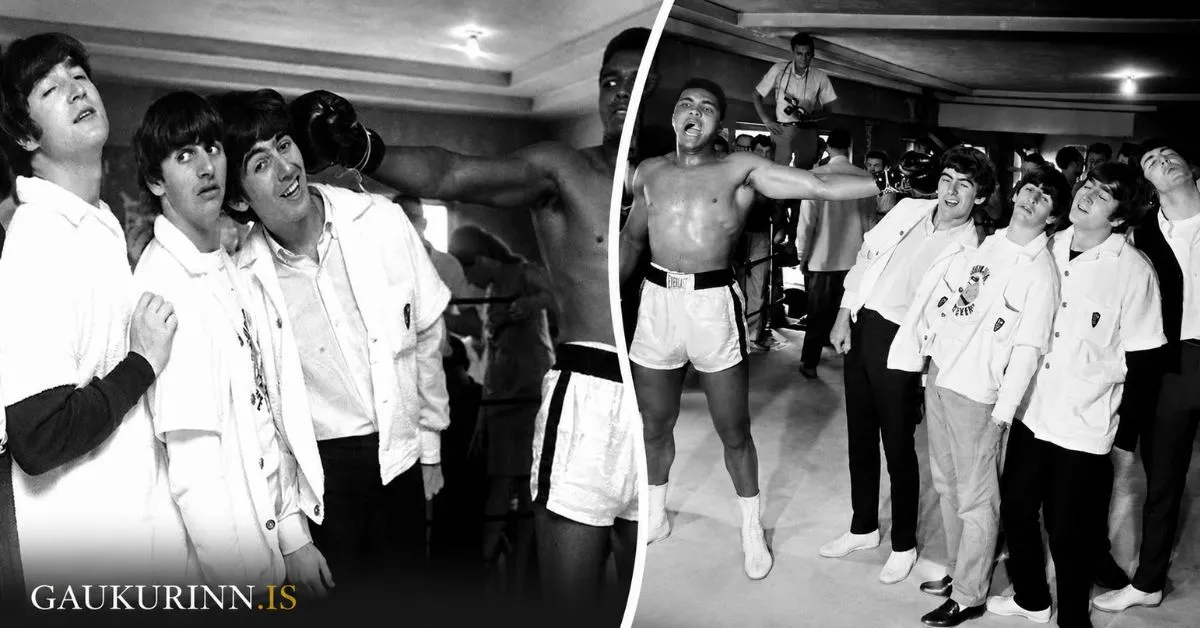
Quick answer: The Beatles and Muhammad Ali met on February 18, 1964, at the 5th Street Gym in Miami Beach, Florida. The encounter—arranged as a publicity stunt days before Ali’s world heavyweight title fight against Sonny Liston—produced one of the most reproduced photographs in 20th-century pop culture history.
There’s a photograph that stops people cold, even sixty years after it was taken. Four young men from Liverpool—mop-topped, grinning, wearing matching dark suits—are lying on a gymnasium floor, pretending to be knocked out. Standing over them, fist raised and eyes wide with theatrical triumph, is a 22-year-old heavyweight boxer who hadn’t yet won the world title. The image is chaotic, joyful, and somehow inevitable. It looks like the sixties invented itself in a single frame.
That image was taken on February 18, 1964, at the 5th Street Gym in Miami Beach, Florida. On one side: The Beatles, just four days removed from their debut on The Ed Sullivan Show and still adjusting to the reality of American Beatlemania. On the other: Cassius Clay, five days before his first fight with Sonny Liston—the fight that would change his name, his religion, and the world’s understanding of what a heavyweight champion could be.
Related Stories



The meeting of The Beatles and Muhammad Ali wasn’t planned with any particular reverence for history. It was a photo opportunity. A stunt. Two publicity machines colliding in a Florida gym on a Tuesday afternoon. And yet, the moment they shared—rowdy, theatrical, and crackling with energy—became something no publicist could have scripted. It became a symbol.
This feature explores the full story of that meeting: who these men were at that precise moment in 1964, how the encounter was arranged, what the cameras captured, and why the image they left behind remains one of the most enduring in modern cultural history.
Historical Snapshot
To understand the significance of February 18, 1964, it helps to place each party exactly where they stood—not in hindsight, but in real time.
Who were The Beatles in February 1964?
The Beatles—John Lennon, Paul McCartney, George Harrison, and Ringo Starr—had arrived in New York on February 7, 1964, to a reception that genuinely shocked them. Thousands of fans had gathered at JFK Airport. The Ed Sullivan Show appearance two days later drew an estimated television audience of 73 million viewers, roughly 40 percent of the entire U.S. population at the time. Beatlemania, as the British press had already named it, crossed the Atlantic fully intact.
By the time the group flew to Miami for their second Sullivan appearance, they were the most-talked-about act on the planet. But they were also, in many meaningful ways, still four working-class kids from Merseyside who found the whole spectacle genuinely surreal.
Who was Muhammad Ali (then Cassius Clay) in February 1964?
Cassius Marcellus Clay Jr. was 22 years old, a gold medalist from the 1960 Rome Olympics, and a professional fighter with a record of 19–0. He was also, by most mainstream accounts, an irritating loudmouth who talked too much and probably didn’t stand a chance against the terrifying Sonny Liston. Sports Illustrated largely dismissed his chances. The oddsmakers agreed.
What the oddsmakers didn’t know—or wouldn’t acknowledge—was that Clay had spent weeks studying Liston’s tendencies, training with extraordinary discipline, and preparing for the specific fight Liston wouldn’t expect. He was also, privately, already in contact with the Nation of Islam, a fact he would disclose publicly the day after the Liston fight.
Clay was, in short, five days from one of the greatest upsets in boxing history and on the cusp of an even greater personal transformation. He just wasn’t famous enough yet for most people to care.
How Did The Beatles and Muhammad Ali Come to Meet in Miami?
The meeting was arranged by a Beatles promoter and a boxing publicist who recognized that two rising stars could amplify each other’s profiles—though, at the time, only one of them was already famous.
Harold Conrad, a publicist working the Liston-Clay fight, had the idea. He reached out to Brian Epstein, The Beatles’ manager, proposing a visit to the 5th Street Gym. The logic was sound from a boxing standpoint: Clay needed the exposure. He had the charisma, the quotability, and the physical presence—but mainstream America still didn’t take him seriously as a fighter.
The Beatles, by contrast, had more attention than they knew what to do with. Conrad figured that some of that light might spill onto Clay.
Epstein agreed. The Beatles were based at the Deauville Hotel in Miami Beach and had been given unusual access to the city—boat rides, beach time, a level of privacy they couldn’t get in New York. A trip to a gym fit the looseness of their schedule.
What nobody had anticipated was how naturally the encounter would ignite.
What Happened at the 5th Street Gym on February 18, 1964?
When The Beatles arrived at the 5th Street Gym, Cassius Clay immediately took control of the room—performing for the cameras with a theatrical energy that matched the band’s own.
Initially, Clay wasn’t even planning to show up. According to multiple accounts from those present, he had been dismissive of the invitation. “The Beatles? I don’t know nothing about no Beatles,” he reportedly said. But he came. And the moment he walked in, the dynamic shifted.
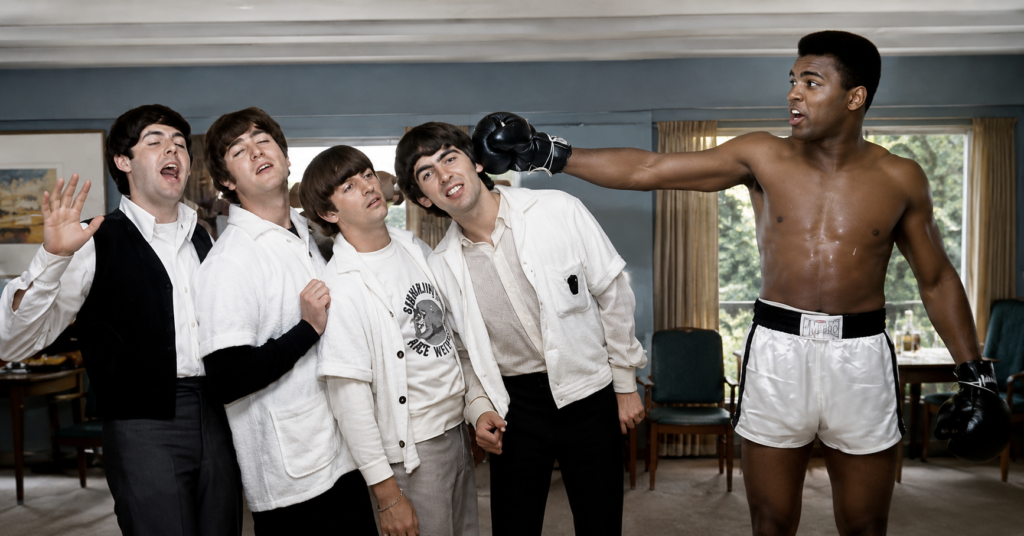
Clay was in full performance mode from the start. He rounded the four musicians up, posed them together, shouted “I am the greatest!” with a grin that could light a room, and directed the session with the instincts of someone who understood spectacle viscerally. Photographer Harry Benson, embedded with The Beatles during the American tour, captured the sequence of images that would define the afternoon.
The most famous photograph shows Clay standing over all four Beatles, who are played out flat on the canvas in mock defeat. Clay’s fist is raised. His face is a portrait of mock fury and barely contained laughter. The Beatles look delighted—not overwhelmed, not starstruck, but genuinely in on the joke.
John Lennon, by most accounts, was the quietest of the four. Paul McCartney engaged with Clay most directly. Ringo Starr clowned alongside him. George Harrison, who had been suffering from a throat infection throughout the American visit, still made the trip.
The whole session lasted less than an hour. By the time it ended, something had been made that neither party could have manufactured alone.
How Did the Media React to the Beatles and Muhammad Ali Meeting?
The encounter generated significant press coverage at the time, though the deeper cultural meaning of the photographs took decades to fully materialize.
In 1964, the immediate media reaction split along predictable lines. The Beatles coverage was largely ecstatic—anything involving the group was guaranteed column inches. The Clay coverage was more complicated. American sports media was still operating within a framework that positioned the loud, self-promoting Clay as an antagonist. The photographs with The Beatles were treated by some outlets as a curiosity or a novelty.
Harry Benson’s images were widely distributed through press wire services, appearing in newspapers across the United States and the United Kingdom. The photo of Clay standing over the four prone Beatles ran in publications around the world.
But the image’s real power emerged later—once Clay had beaten Liston, announced his conversion to Islam, changed his name to Muhammad Ali, refused military induction, and become one of the most politically consequential athletes in American history. Suddenly, the photograph wasn’t just a publicity stunt. It was the moment two of the most transformative cultural forces of the 20th century had shared a room, and nobody had quite grasped what they were witnessing.
What Is the Cultural Impact of the Beatles and Muhammad Ali’s 1964 Meeting?
The 1964 meeting has endured as a defining cultural artifact because it captured two revolutionary forces—in music and in sport—at the precise moment before each changed the world.
It’s rare for a single photograph to carry this much interpretive weight. But the Beatles and Muhammad Ali image works on multiple levels simultaneously.
First, it documents a specific historical instant: a Tuesday afternoon in Miami, 1964, when fame was still new and the stakes hadn’t yet revealed themselves. Second, it functions as a metaphor for the decade about to unfold—the collision of British rock culture with American counterculture, the disruption of old hierarchies, the insistence that young people could be loud and defiant and still be taken seriously.
Ali would go on to win the heavyweight championship five days later, in a stunning eighth-round stoppage. He would announce his membership in the Nation of Islam the following morning. He would be stripped of his title in 1967 for refusing Vietnam-era military service, return in 1974 to defeat George Foreman in Kinshasa, and retire as a three-time heavyweight champion and arguably the most famous person on earth.
The Beatles would record A Hard Day’s Night, Revolver, Sgt. Pepper’s Lonely Hearts Club Band, and Abbey Road before breaking up in 1970. They redefined what popular music could aspire to be.
Between them, they generated one of the most photographed, most analyzed, and most celebrated moments of a decade defined by photographed, analyzed, and celebrated moments.
Why Does the Beatles and Muhammad Ali Meeting Still Matter Today?
The moment endures because it represents an intersection of cultural forces that would separately define the 20th century, captured before either story had fully played out.
Photographs earn their permanence by accumulating meaning over time. The Benson image of Clay and The Beatles has done exactly that. Every year that passed added another layer: Ali’s civil rights significance, Lennon’s assassination, the ongoing cultural primacy of The Beatles’ catalog, the global reach of Ali’s image as a symbol of dignity and resistance.
The photograph is now reproduced on gallery walls, in retrospective exhibitions, in documentary films, and in academic texts analyzing the cultural politics of the 1960s. It appears in books about boxing, books about music, books about race in America, books about celebrity and media.
There is also something worth noting in the sheer human warmth of the image. These are not two cultural monuments posing solemnly for posterity. They are young men laughing. Clay is performing with total commitment to the bit. The Beatles are going along with it, happily, without ego. For one afternoon in a Miami gym, nobody was the bigger star. They were just people in a room, making something joyful.
That, as much as anything, is why the moment still matters.
Frequently Asked Questions
What is the Beatles and Muhammad Ali connection?
The Beatles and Muhammad Ali are connected by a famous encounter that took place on February 18, 1964, at the 5th Street Gym in Miami Beach, Florida. The meeting was arranged as a publicity event days before Ali’s first fight with Sonny Liston and The Beatles’ second appearance on The Ed Sullivan Show. It produced iconic photographs that have since become defining images of 1960s culture.
When did The Beatles meet Muhammad Ali?
The Beatles met Muhammad Ali—then known as Cassius Clay—on February 18, 1964. The meeting took place at the 5th Street Gym in Miami Beach, Florida, during The Beatles’ first American tour.
Where was the famous Beatles and Muhammad Ali photo taken?
The photograph was taken at the 5th Street Gym in Miami Beach, Florida. Photographer Harry Benson, who was traveling with The Beatles throughout their first American tour, captured the session. The most famous image shows Ali standing over all four Beatles, who are lying on the gym floor in mock defeat.
Did Muhammad Ali know who The Beatles were before they met?
According to contemporary accounts from those present, Ali was initially dismissive of the meeting and claimed not to know who The Beatles were. Despite this, he attended the session and immediately took command of it, directing the photographs with characteristic showmanship. Whether his unfamiliarity was genuine or performed is debated by historians.
What happened to The Beatles and Muhammad Ali after their 1964 meeting?
After the Miami meeting, Ali defeated Sonny Liston five days later to win the world heavyweight championship and announced his conversion to Islam the following day, changing his name from Cassius Clay. The Beatles continued their first American tour, returned to the UK, and entered their most creatively prolific period. The two cultural forces never had another documented formal encounter, though Ali and Lennon later expressed mutual admiration publicly.
A Meeting That History Made Magnificent
Two forces, one gymnasium, one Tuesday afternoon. At the time, it was a photograph. With the passage of sixty years, it has become something closer to a document—evidence that history sometimes announces itself with a laugh and a raised fist rather than a formal declaration.
The Beatles and Muhammad Ali did not change each other’s trajectories that February afternoon in Miami. They were each already on a course that would reshape their respective corners of the world. But the image they made together—chaotic, exuberant, and entirely unrehearsed—captured something that no biography can quite replicate: the feeling of being young and extraordinary and aware, on some level, that the world was about to belong to you.
That feeling translates across every decade. It’s why people still stop when they see the photograph. And it’s why, sixty years on, that Tuesday in Miami still feels like it matters.

Emma Clarke is a content writer at Gaukurinn.is, specializing in celebrity news, pop culture, movies, and music. With a strong focus on accuracy and trending topics, she creates engaging and well-researched articles that keep readers informed and entertained.
Emma follows trusted sources and editorial standards to ensure content is reliable, relevant, and up to date. Her goal is to deliver clear, valuable information that readers can trust.